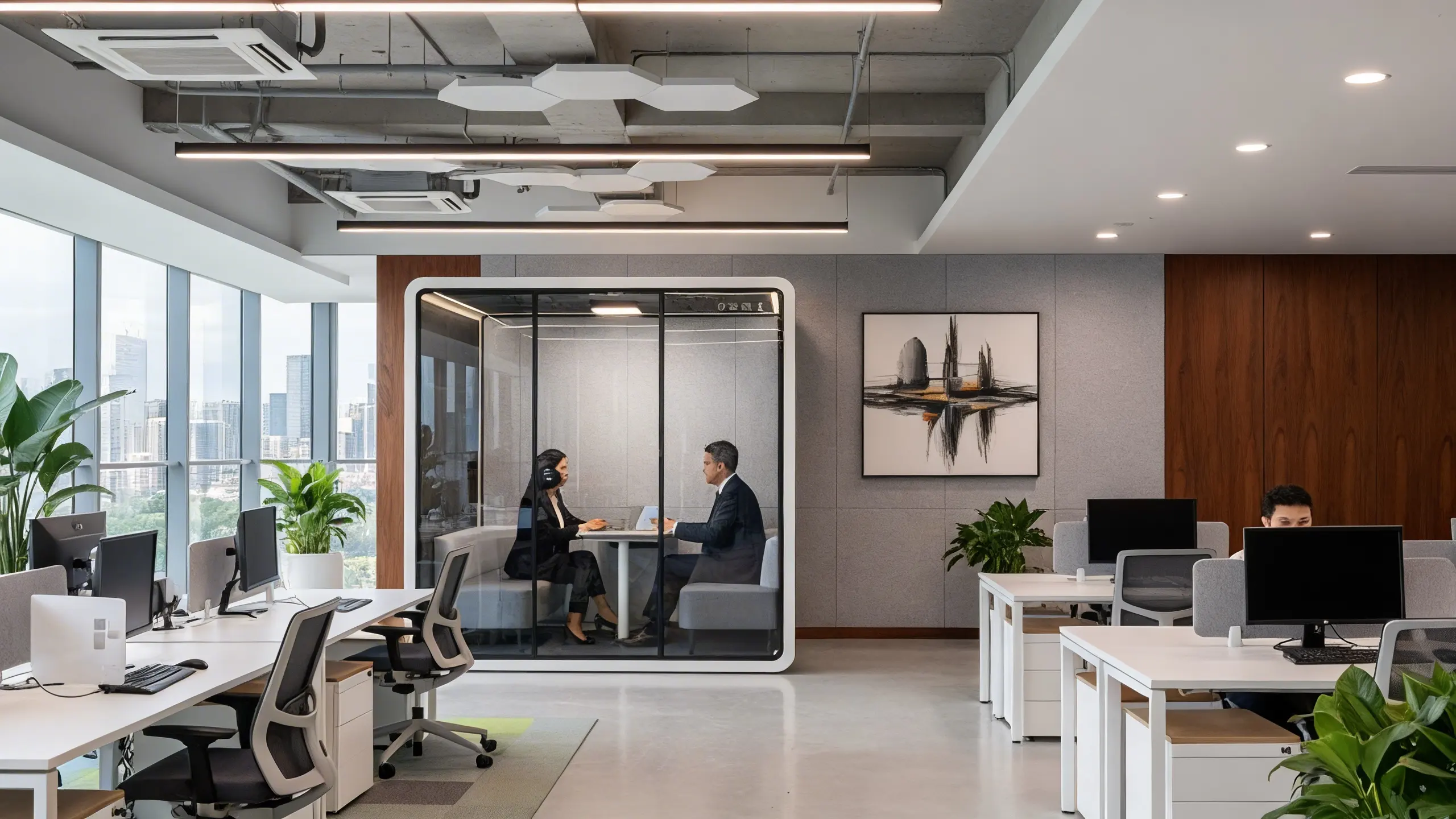
Open Office Noise & Productivity: How Interruptions Affect Focus

Explore how open office interruptions affect focus, why workplace acoustics matter, and how acoustic pods support privacy and different ways of working.

Modern workspace solutionspopular science articleSoundproof Booth Solutions

August 10, 2026

Open Office Noise & Productivity: How Interruptions Affect Focus

Open office interruptions can make it harder to stay focused. Research by UC Irvine informatics professor Gloria Mark found that after an interruption, it can take around 23 minutes on average to return to the original task. For open workplaces, the takeaway is simple: reducing unnecessary distractions and giving people access to acoustic privacy can help create better conditions for focused work.


You’ve probably been there:

You’re deep into a proposal, your ideas are flowing, and you’re fully focused on solving the problem in front of you. Then a phone rings nearby. A three-minute conversation breaks your concentration — but the real impact comes afterward. You reopen your document, reread your last few sentences, and spend valuable time trying to rebuild the focus you lost.

In an open office, these small interruptions can happen throughout the day, repeatedly breaking concentration and making deep work harder to maintain.

This is the hidden cost of workplace interruptions: not just the distraction itself, but the effort required to regain focus.


1. Calculating the Hidden Cost: The Impact on Each Employee

The real cost of an interruption is not simply the few minutes it lasts. What matters is what happens to our focus afterward.

When attention shifts away from a task, returning to it often means finding where you left off, rebuilding your train of thought, and regaining momentum.The impact can be especially noticeable during work that requires sustained concentration, such as writing, analysis, design, or problem-solving.

And not every interruption has the same impact. A quick distraction during a routine task may be easy to recover from, while the same interruption during deep work can be far more disruptive.

That is why workplace interruptions should not simply be calculated as “lost time.” The bigger challenge is creating an environment where people have greater control over when they collaborate — and when they need to focus.

https://oss.soundbox-pod.com/markdown/employeefocusingonworkwhileconversationsandactivitycreatedis-20260821092114-2469e041.webp

2. The Open Office Trade-off

Open offices were designed around a compelling idea: remove physical barriers to encourage communication, collaboration, and a more connected workplace.

But fewer physical boundaries can also mean greater exposure to surrounding conversations, movement, and noise. What supports collaboration in one moment can become a distraction in another.

The challenge becomes especially clear when work requires privacy. Phone calls can be overheard, sensitive conversations may be difficult to hold at a desk, and focused work has to compete with the activity happening around it.

The issue is not collaboration versus focus. Modern workplaces need both.

A better open office gives people the freedom to interact when collaboration matters — and access to greater privacy when concentration or confidential conversations require it.

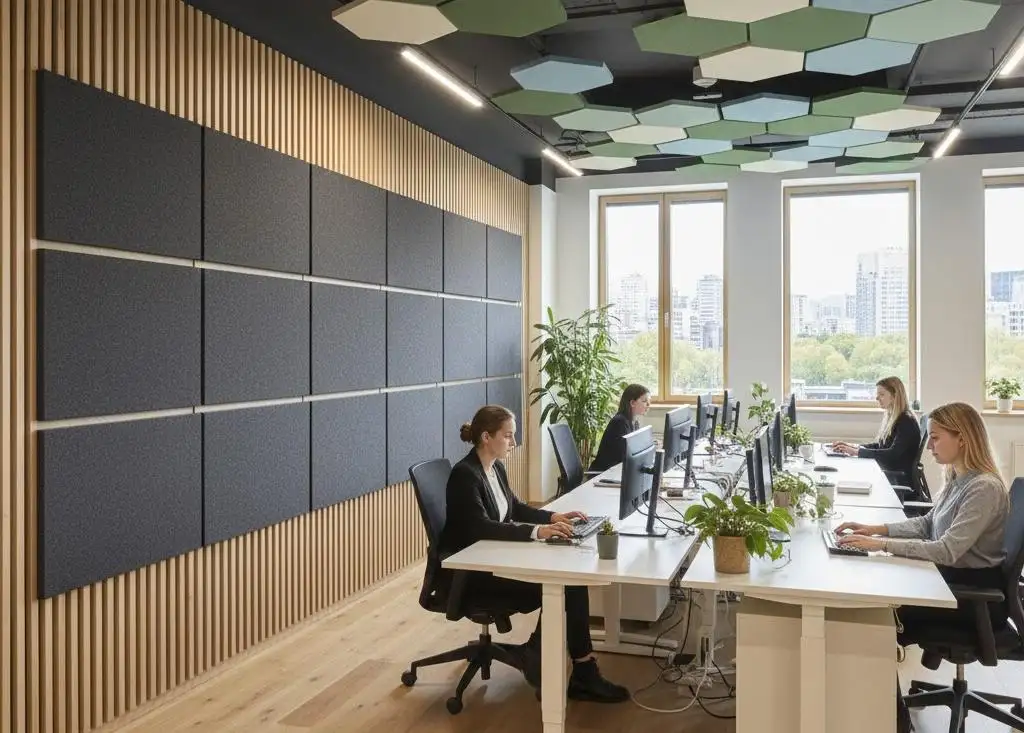
https://oss.soundbox-pod.com/markdown/focusedemployeeworkingindependentlywhilecolleaguescollaborat-20260821092345-d871040a.webp

Without that balance, some of the everyday challenges of open office environments become more noticeable:

  • Reduced focus: Surrounding conversations, movement, and background noise can make sustained concentration more difficult.
  • Limited privacy: Calls and sensitive conversations can be harder to manage when there is little separation from surrounding work areas.
  • Competing work modes: Focused work, calls, meetings, and collaboration often happen within the same environment, even though they require different levels of privacy and concentration.
  • Less control over the environment: Employees have fewer options to choose a setting that matches the task at hand.

The challenge, then, is not simply reducing noise. It is creating a workplace that can support different ways of working within the same environment.

That starts with something that is often overlooked: acoustics​.


3. Acoustics: Designing for Different Ways of Working

Acoustics is an important part of how a workplace supports different activities. The goal is not to make an entire office silent but to manage how sound behaves across the space, so areas for conversation, collaboration, and focused work can function alongside one another.

In practice, workplace acoustics can involve several complementary approaches:

  • Sound absorption — Using materials and acoustic treatments to reduce reverberation within a space.
  • Sound isolation— Using physical separation and construction to limit sound transmission between different areas.
  • Sound masking — Introducing controlled background sound to help reduce the intelligibility and noticeability of surrounding speech.
  • Space Planning— Organizing different work activities across the office so that quieter and more active areas are better separated.

These approaches can be used individually or together depending on the workplace, its layout, and how the space is used.

But not every workplace needs a complete redesign to create more acoustic privacy. For teams that need flexible spaces for focused work, calls, or private conversations, there is another option.

Acoustic pods

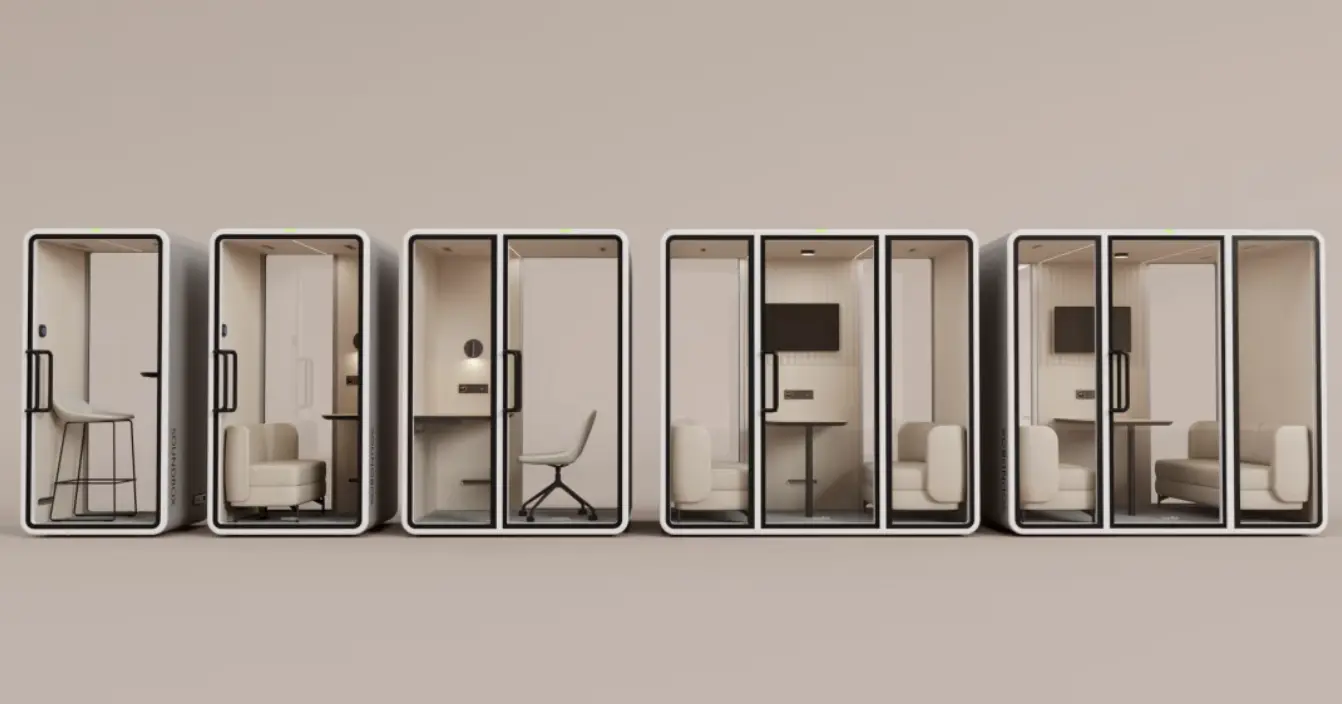
https://oss.soundbox-pod.com/markdown/soundboxacousticpodsindifferentsizesdesignedforfocusedworkca-20260821092945-764c6e07.webp

4. Acoustic Pods: Flexible Spaces for Focus and Privacy

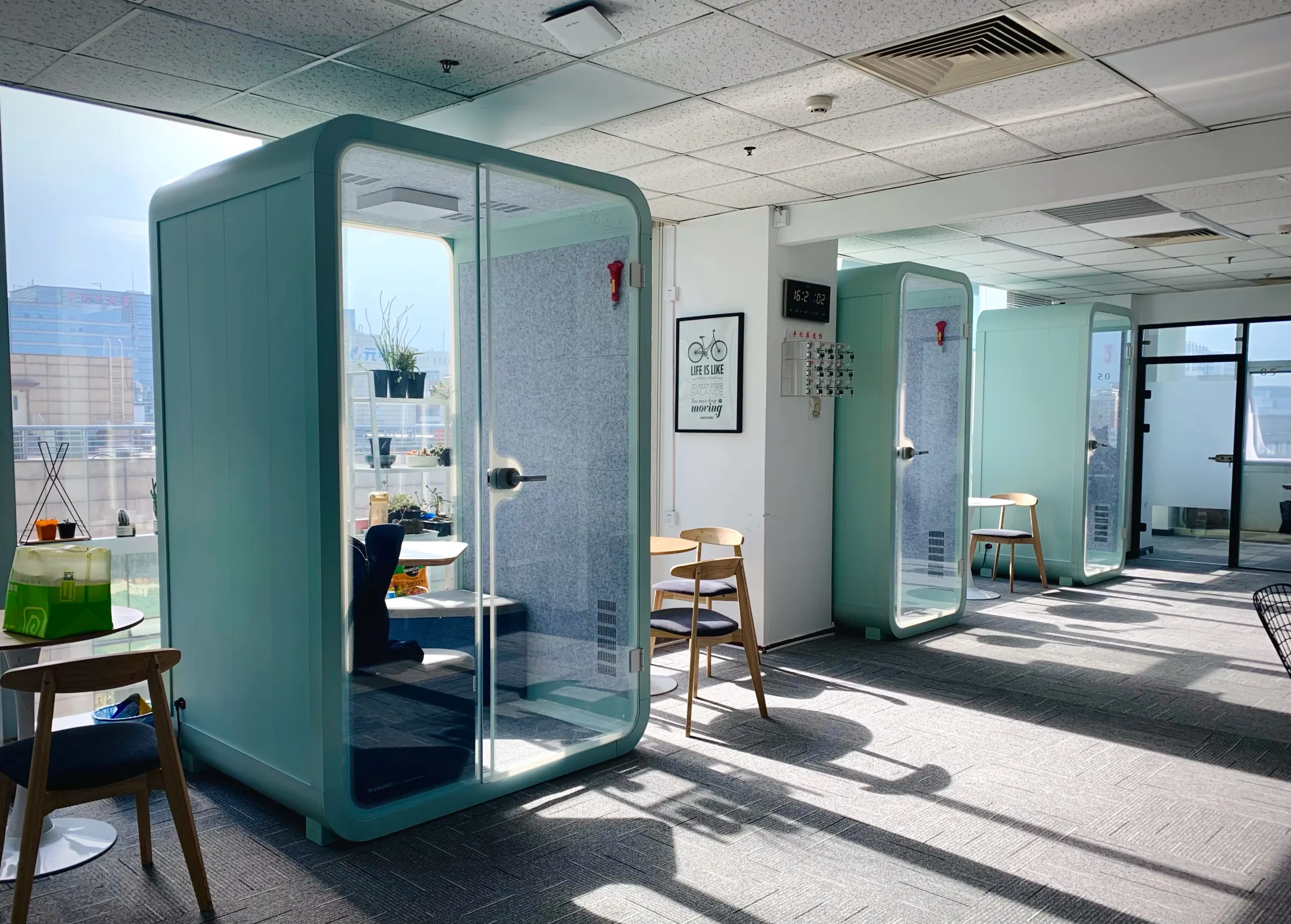
Acoustic pods, also known as office pods, soundproof office pods, or private work booths, are self-contained spaces designed to add greater acoustic privacy to modern workplaces. They create dedicated spaces for focused work, calls, and conversations without the need to build permanent rooms.

Because they are modular, pods can be introduced as workplace needs change, giving teams another way to support different work modes within an open office.

So, what can an acoustic pod do?
https://oss.soundbox-pod.com/markdown/acousticpodusesforprivatecallsfocusedworkvideomeetingsrecord-20260821093557-a069af0c.webp

Inside a Soundbox Acoustic Pod

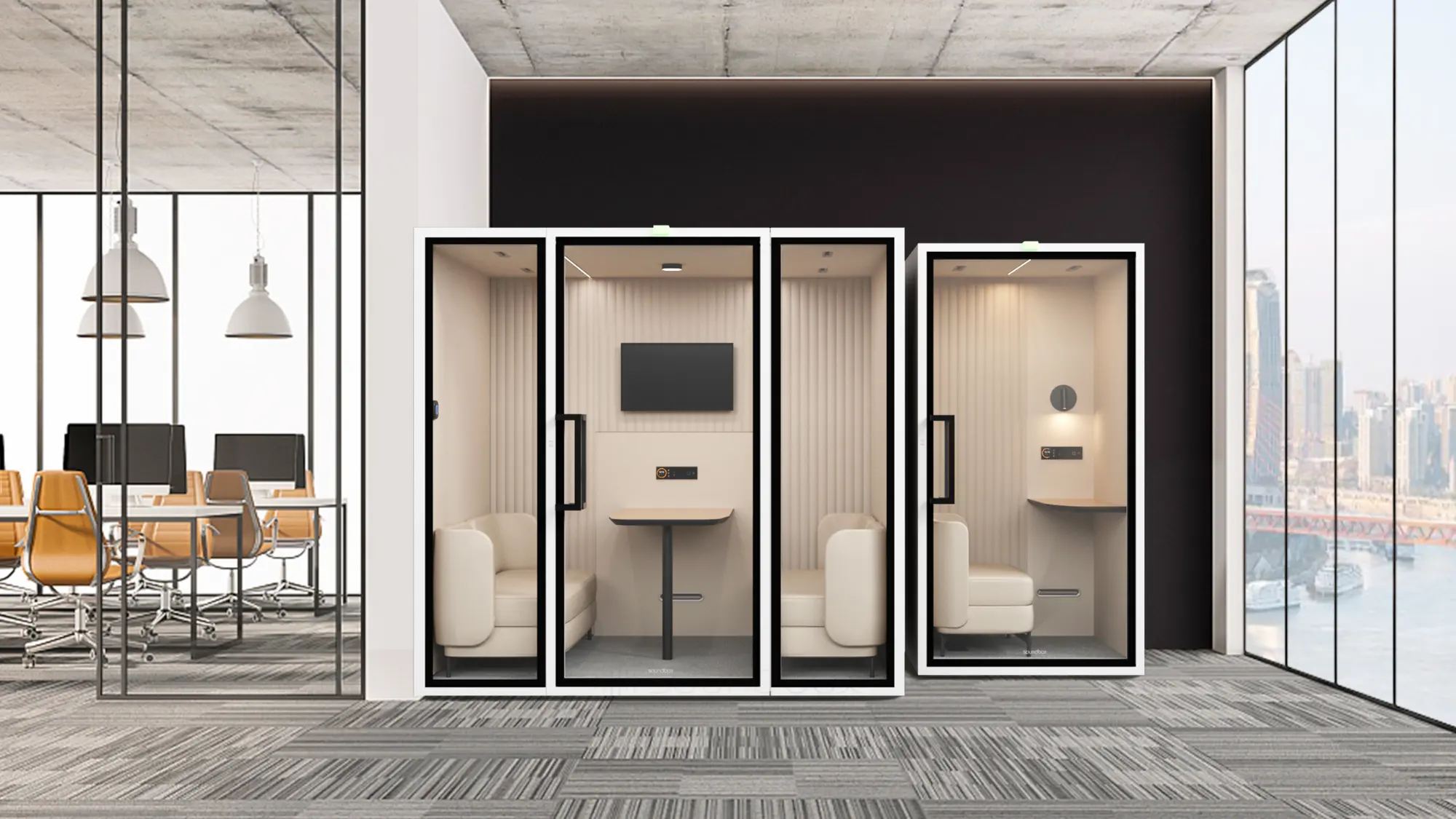
A Soundbox acoustic pod combines the essential features needed for focused work, calls, and meetings within one private workspace.

https://oss.soundbox-pod.com/markdown/soundboxacousticpodinteriorwithsmartcontrolscomfortableseati-20260821093734-473c463d.webp
  • Acoustic privacy: Composite acoustic panels, aluminum framing, and laminated acoustic glass help create greater separation from surrounding workplace activity. Tested sound insulation performance reaches a weighted sound level difference (Dp,w) of up to 30 dB.
  • Continuous fresh air circulation: An integrated ventilation system provides up to 46 air changes per hour​, helping maintain fresher air during focused work, calls, and meetings.
  • Adjustable lighting and controls: Built-in controls let users adjust lighting and ventilation from inside the pod, including brightness and color temperature for different work modes.
  • Work-ready interior: Seating, work surfaces, and integrated power support everyday activities from individual focus to calls and meetings, depending on the pod configuration.
  • Modular installation: The all-bolt structure supports dust-free, glue-free assembly. The pod can be disassembled, relocated, and reassembled as workplace needs change, extending its use across different spaces.

5. So, Was the Open Office Really a Mistake?

Perhaps the problem for this question was never about the office itself. It was the expectation that one type of space could support every kind of work.

Work changes throughout the day. A conversation becomes a call. Collaboration gives way to concentration. A quick discussion may turn into something that requires privacy. Yet the physical workplace does not always change with us.

That may be the next evolution of workplace design: not choosing between open and closed, but creating spaces that can respond to what people need in the moment.

The best workplace may not be the one with the fewest distractions or the most collaboration. It may simply be the one that gives people more control over where and how they work.