US employers assessing occupational noise need to consider both sound level and exposure duration. A decibel reading captures the sound level at a particular moment, while an occupational exposure assessment considers how that level changes throughout the workday and how long an employee is exposed to it.
OSHA noise exposure limits for general industry
For general industry, OSHA’s Occupational Noise Exposure Standard, 29 CFR 1910.95 establishes a permissible exposure limit of 90 dBA as an eight-hour time-weighted average. When employee exposure equals or exceeds an eight-hour time-weighted average of 85 dBA, OSHA defines this as the action level for its hearing conservation requirements.
The 85 dBA action level and the 90 dBA permissible exposure limit serve different purposes. Reaching the action level does not mean that the permissible exposure limit has already been exceeded. It triggers requirements that can include exposure monitoring, audiometric testing, hearing protection, employee training and recordkeeping.
OSHA uses a 5 dB exchange rate for its general-industry exposure calculations. Under this approach, each 5 dB increase halves the permissible exposure duration:
| A-weighted sound level | Permissible duration under OSHA Table G-16 |
|---|---|
| 90 dBA | 8 hours |
| 92 dBA | 6 hours |
| 95 dBA | 4 hours |
| 97 dBA | 3 hours |
| 100 dBA | 2 hours |
| 102 dBA | 1.5 hours |
| 105 dBA | 1 hour |
| 110 dBA | 30 minutes |
| 115 dBA | 15 minutes or less |
These durations are part of OSHA’s exposure calculation and should not be treated as general comfort targets. Where an employee experiences several noise levels during one shift, the separate periods must be combined using OSHA’s method rather than assessed individually. OSHA provides the applicable dose and TWA calculations in Appendix A to 29 CFR 1910.95.
OSHA and NIOSH use different calculation methods
The National Institute for Occupational Safety and Health takes a different approach. NIOSH recommends an occupational noise exposure limit of 85 dBA over eight hours and uses a 3 dB exchange rate. Under the NIOSH method, each 3 dB increase halves the recommended exposure duration.
| Comparison point | OSHA general-industry framework | NIOSH recommendation |
|---|---|---|
| Status | Enforceable federal workplace standard within its scope | Recommended exposure limit |
| Eight-hour level | 90 dBA permissible exposure limit | 85 dBA recommended exposure limit |
| Exchange rate | 5 dB | 3 dB |
| Four-hour example | 95 dBA | 88 dBA |
| Two-hour example | 100 dBA | 91 dBA |
The OSHA and NIOSH figures should be clearly labeled. Results obtained or calculated under one framework should not be compared directly with a limit from the other without accounting for differences in exchange rates, measurement thresholds and calculation settings.
The applicable requirements also depend on the industry and jurisdiction. Construction, maritime and other sectors may be covered by different provisions, and OSHA-approved State Plans may impose requirements that need to be reviewed separately. Employers should identify the rules applying to the particular workplace before using these figures in a compliance assessment.
A spot reading is not a daily exposure assessment
A reading taken beside a desk or machine shows the sound level at that location and moment. It does not establish an employee’s eight-hour exposure, which depends on both the levels encountered and the time spent at each level.
Choose the right measurement method
- A sound level meter measures sound at a specific location. It can help identify noise sources and compare conditions across work areas.
- A personal noise dosimeter is worn throughout the work period and tracks exposure over time. It is generally the better choice when employees move between locations or perform tasks with different noise levels.
A generic sound-level app can be useful for an initial check, but it should not automatically be used for compliance measurements. The NIOSH Sound Level Meter app is designed to measure workplace noise, but the accuracy and intended use of its results still depend on the device, microphone, settings, calibration and measurement procedure.
Plan representative monitoring
If available information suggests that an employee’s exposure may reach an eight-hour TWA of 85 dBA, OSHA’s general-industry standard requires the employer to implement a monitoring program.
The sampling plan should reflect the work employees actually perform, including the equipment they use, where they work, how long they spend near each source and whether the noise is continuous, intermittent or impulsive. Measurements should include normal operations and regularly recurring high-exposure tasks.
Use instrument settings that match the exposure framework and calibrate the equipment as required. Document the employees or exposure groups assessed, the tasks and operating conditions observed, the measurement period, instrument details and calibration, and the resulting sound level, TWA or noise dose.
Act on the findings
Employees exposed at or above OSHA’s 85 dBA action level must be informed of the monitoring results and allowed to observe required measurements. Monitoring must be repeated when changes to equipment, processes, production or controls could increase exposure or make existing hearing protection inadequate.
If exposure exceeds OSHA’s permissible levels, employers must implement feasible engineering or administrative controls. Options may include modifying or maintaining equipment, enclosing or isolating the source, increasing the distance from employees or limiting the time spent in higher-noise areas. Hearing protection must be provided where required, but it does not replace appropriate controls.
A hearing conservation program includes exposure monitoring, audiometric testing, hearing protection, training and recordkeeping. Where hazardous noise may be present, employers should consider engaging an occupational hygienist or another qualified noise professional to plan the assessment and interpret the results.
Office distraction is a separate question
Occupational noise limits are intended to address the risk of hearing damage from noise exposure. They are not design targets for concentration, speech privacy or general acoustic comfort.
Speech and calls can interrupt focused work at levels well below OSHA’s occupational-exposure thresholds. A workplace may therefore comply with an occupational-noise limit while employees still experience distraction, excessive reverberation or insufficient speech privacy.
These workplace acoustic issues should be assessed separately:
| Observed issue | Questions to examine | Possible response |
|---|---|---|
| Nearby conversations interrupt focused work | Where is the speech coming from, and who is affected? | Layout changes, activity zoning, operating rules or an enclosed setting |
| Speech sounds overly reverberant or unclear | Are hard surfaces creating excessive reflection or reverberation? | Absorptive wall or ceiling treatments |
| Conversations are heard in an adjoining area | Is sound passing through doors, glazing, partitions, ceilings or ventilation paths? | Sound-isolation measures addressing the complete transmission path |
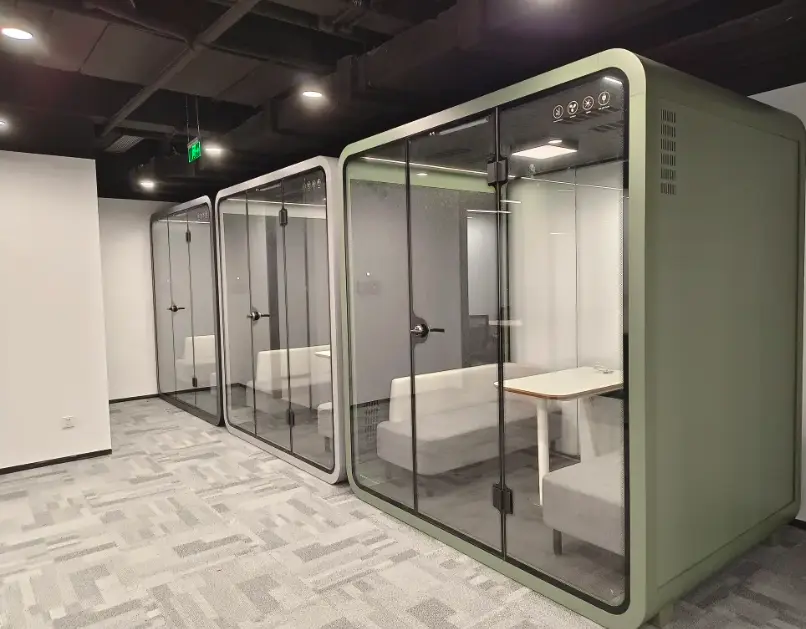
| Employees have nowhere suitable for calls | Is the issue capacity, location, booking or the absence of an enclosed setting? | Quiet rooms, phone booths or acoustic pods |
| Equipment or building services create persistent noise | Can the source be maintained, replaced, isolated or relocated? | Source control and review by the appropriate technical professional |
Absorptive panels and enclosed pods serve different purposes. Absorptive treatments can reduce reflected sound within a room, but they do not automatically block sound from entering or leaving it. An acoustic pod can provide an additional enclosed setting for calls or focused work, but it should not be represented as a substitute for industrial noise controls, a hearing conservation program or a site-specific occupational-exposure assessment.
Where the issue is office speech distraction rather than hazardous occupational noise, a Soundbox acoustic podmay be one part of the workplace response. Selection should consider the intended activity, placement, ventilation, accessibility and model-specific acoustic evidence. Other noise sources or room-wide acoustic problems may still require separate treatment.
This article uses the US OSHA framework as an example. Noise-exposure requirements vary by country, industry and workplace, so each site should be assessed against the rules and conditions that apply.