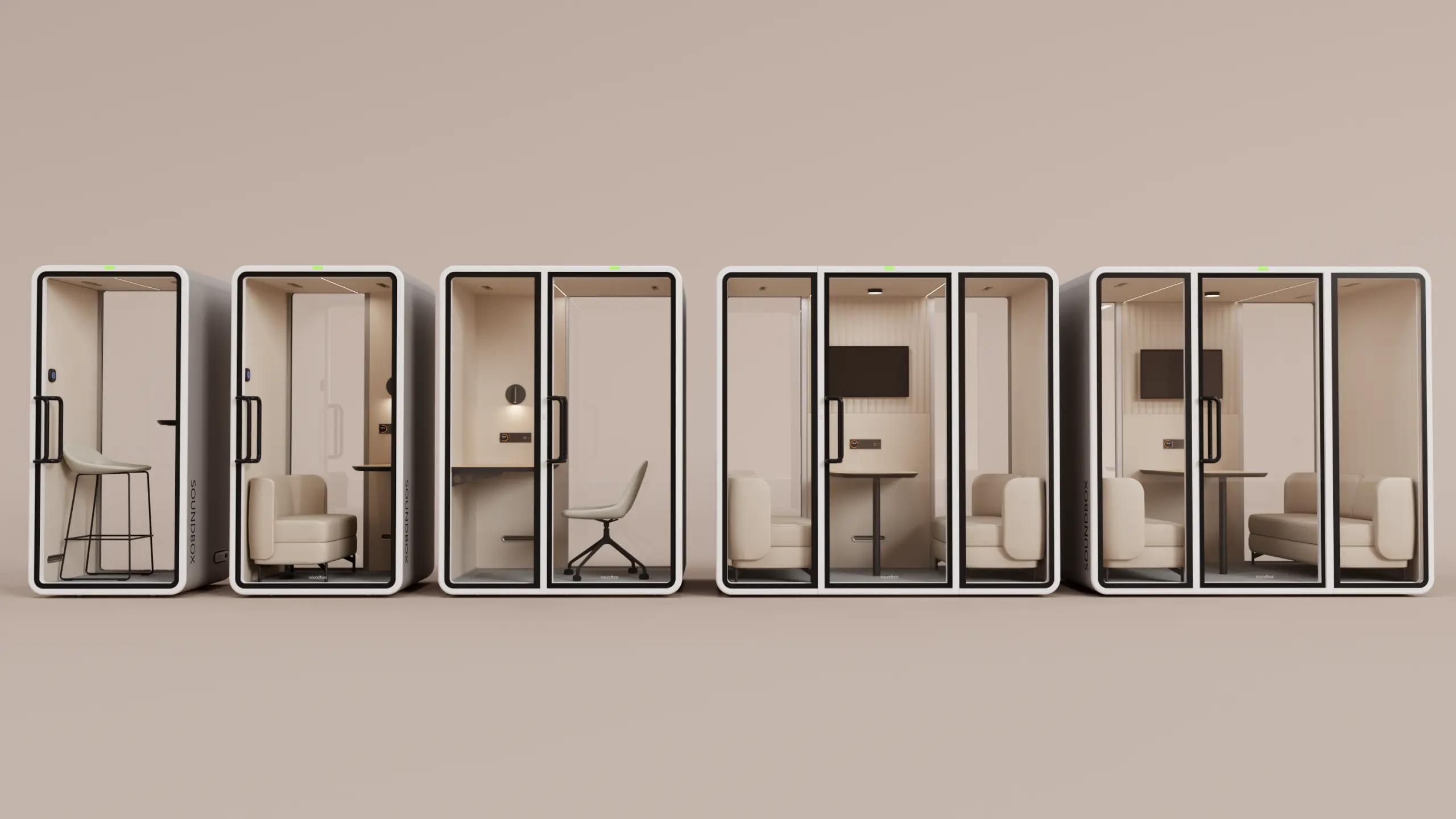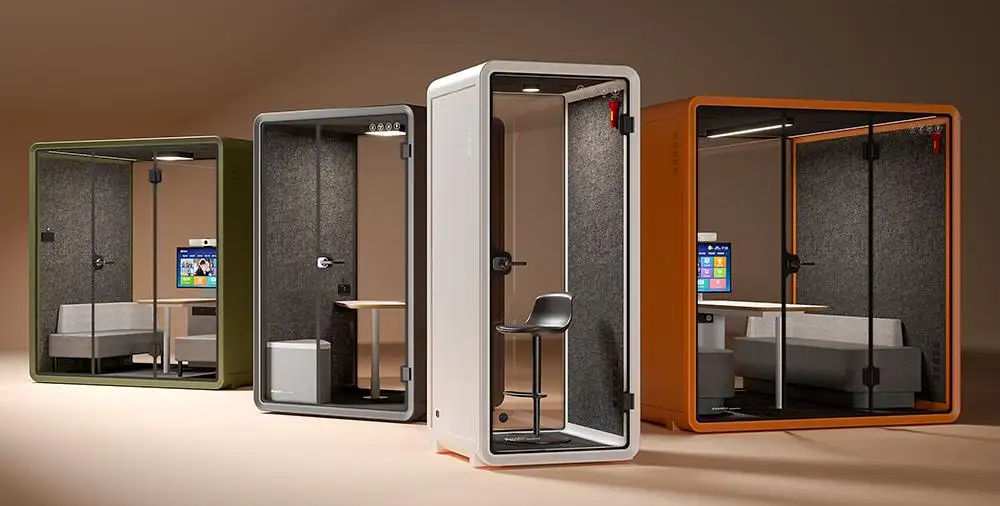
Office pods are commonly grouped by activity and capacity, but occupancy alone does not determine how a pod should be used. A phone booth and a focus pod may both accommodate one person, yet they can differ in workspace, seating, equipment, and suitable session length.
Start with the intended activity, typical occupancy, and expected session length. These factors help narrow the pod category before individual models are compared by dimensions, furniture, integrated services, technical documentation, and site requirements.
The table below provides a general comparison of the main office pod categories.
| Pod type | Primary activity | Typical occupancy | What distinguishes it |
|---|---|---|---|
| Phone booth | Calls and brief video meetings | One person | Compact space for short sessions |
| Focus pod | Concentrated laptop or document work | One person | More support for seated, longer-duration tasks |
| Small meeting pod | Interviews, check-ins and small team meetings | Small groups | Shared table, seating and optional AV |
| Larger meeting pod | Team meetings, project reviews and workshops | Larger groups | Greater capacity and more extensive project coordination |
These categories can overlap. The purpose of the classification is not to assign a fixed label to every model, but to narrow the options according to what people need to do inside the space.
Phone booths
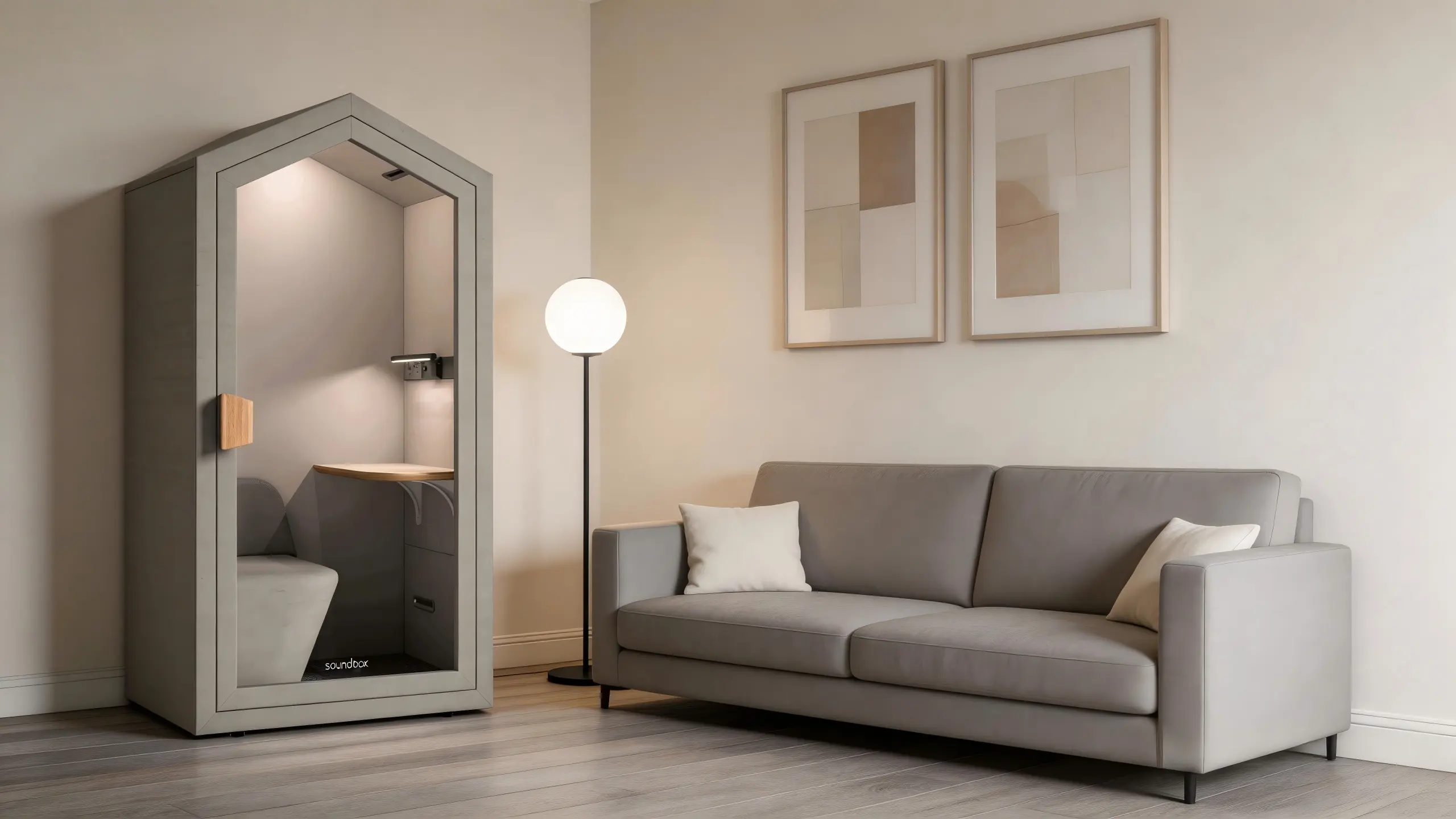
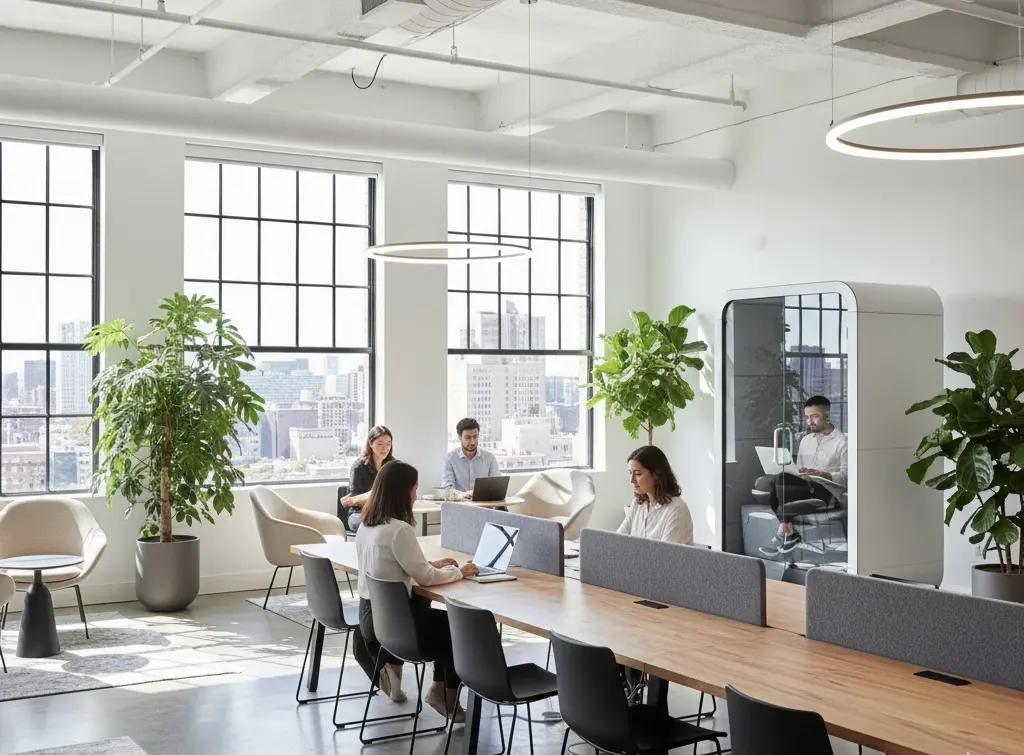
Phone booths are generally intended for calls, brief video meetings and other short activities that benefit from an enclosed setting. Their compact size allows them to be placed near work areas where employees regularly need somewhere to take a call without using a full meeting room.
Brief calls may be taken while standing, while longer calls or video meetings may require seating and space for a laptop or notes. Soundbox phone booths combine a compact work surface with integrated lighting, power, and ventilation. The selected furniture configuration should reflect how the booth will normally be used.
For video calls, check the camera position, facial lighting, and reflections in the glazing from the expected working position. Placement also matters: the booth should be easy to reach, while its door movement and any waiting area should remain clear of nearby circulation routes and workstations.
The office phone booth buyer’s guide explains how to compare dimensions, ventilation, accessibility, acoustic evidence, and project costs. If users regularly need to complete longer periods of laptop work, a focus pod with more workspace and task-appropriate seating may be more suitable.
Focus pods
Focus pods are designed for individual work that requires more time and workspace than a brief call. Typical uses include writing, analysis, document review, online training, and concentrated laptop work.
Although both categories may be designed for one user, a focus pod should not be treated simply as another name for a phone booth. The distinction is in the activity and expected session length. Longer use places greater importance on seating, work posture, table depth, equipment space, ventilation and lighting.
Review the interior using the furniture and equipment that will actually be installed. A user should be able to position a laptop, documents and personal belongings without reducing legroom or blocking the door, sockets or air vents. If a monitor or other equipment is added, account for its power, cable route and heat output.
Workspace, seating, lighting, ventilation, connectivity, and acoustic evidence should be reviewed together for the selected configuration. How to Choose a Focus Pod for Concentrated Work provides a more detailed framework for comparing these requirements against the expected task and session length.
If the primary need is a short call, a phone booth may use the available floor area more efficiently. For longer individual work, the additional workspace and task-appropriate furniture of a focus pod may be more suitable.
Small meeting pods
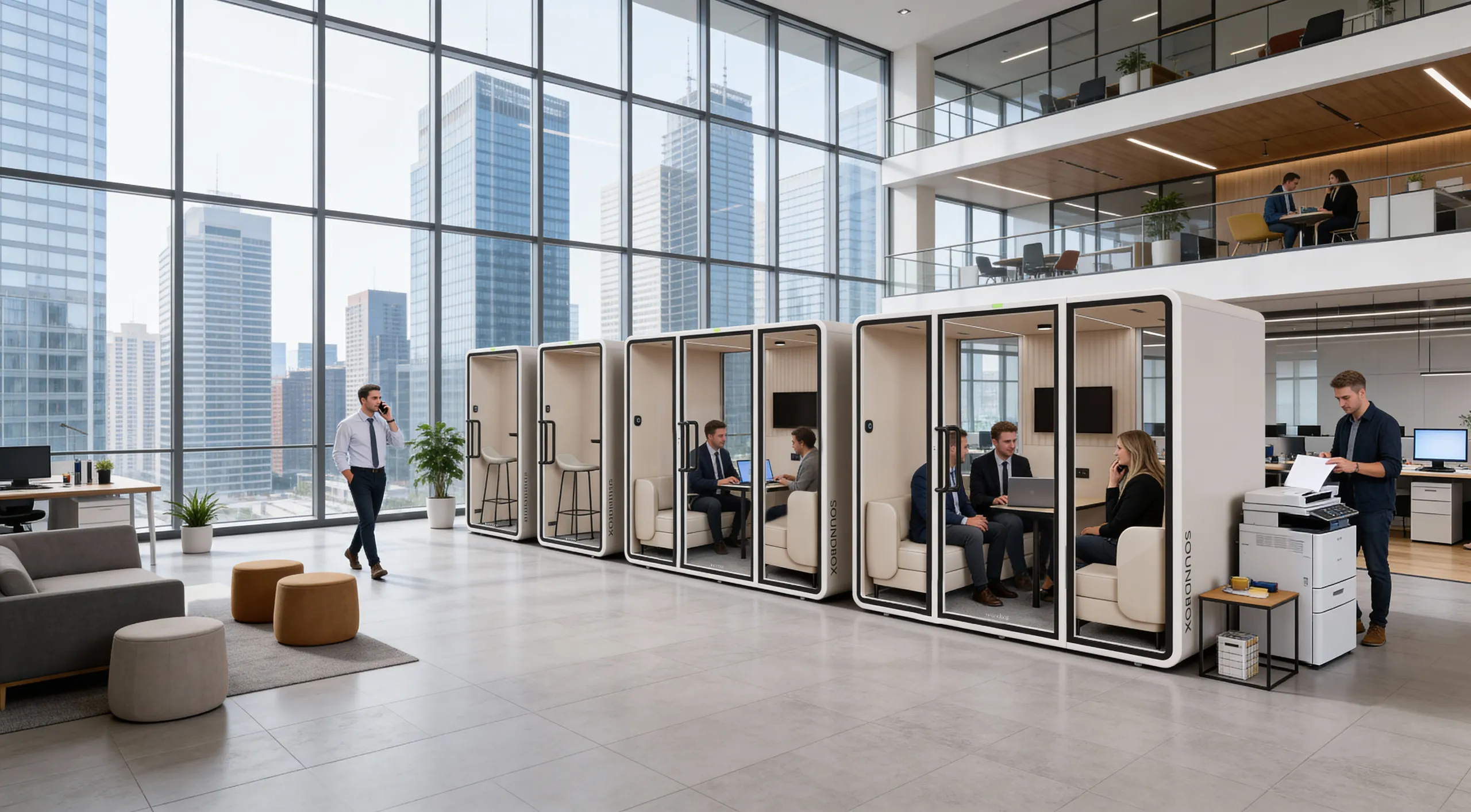
Small meeting pods are suited to interviews, one-on-one conversations, project discussions, and hybrid meetings that do not require a larger meeting room. Soundbox models in this category typically combine shared seating and a table within a compact enclosed space.
Choose capacity based on the group sizes that meet regularly rather than the largest group that may occasionally need a room. Review the usable interior space with the proposed furniture installed, making sure participants have sufficient table space and clear sightlines to one another.
For hybrid meetings, consider how the seating, display, camera, microphone, and cables will work together. Ventilation should also be suitable for the intended occupancy and expected meeting length. Our guide to choosing a meeting pod for team collaboration explains these requirements in more detail.
A small meeting pod may be a good fit for workplaces that regularly host meetings of two to four people. If meetings typically involve larger groups, more equipment, or additional table space, a larger meeting pod may be more appropriate.
Larger meeting pods
Larger meeting pods are intended for team meetings, project reviews, workshops, and longer hybrid sessions. They can accommodate more people, furniture, and equipment than small meeting pods, but require more floor area and site planning.
Choose capacity based on regular attendance rather than the largest group that may occasionally need a room. A pod selected around an occasional maximum may be underused during normal operations.
When comparing a larger pod with a permanent meeting room, consider the usable interior, furniture, technology, ventilation, accessibility, installation, future relocation, and overall project cost. Soundbox pods use modular construction, which may provide greater flexibility where workplace layouts are expected to change. A permanent room may be more appropriate where extensive integration with building systems or a highly customized layout is required.
Confirm that the proposed location and delivery route can accommodate the selected model and its packaged components. Power, data, fire protection, and egress requirements should be reviewed with the responsible project team. The office pod installation and relocation guide provides further guidance on site preparation, delivery, assembly, and future relocation.
Selection checklist
Before selecting a model, confirm the requirements that affect both the pod category and the completed project.
| Selection area | What to confirm |
|---|---|
| Activity, capacity, and duration | The intended use, typical number of users, and expected session length |
| Space and access | Interior and exterior dimensions, furniture layout, door movement, and delivery route |
| Ventilation, power, and accessibility | Ventilation at the intended occupancy, electrical requirements, and access for the expected users |
| Privacy and acoustics | Visual and speech privacy needs, together with acoustic evidence for the exact model and configuration |
| Project requirements | Applicable fire safety, egress, building, and approval requirements |
| Project cost | Product options, freight, delivery, installation, commissioning, maintenance, and possible relocation |
Soundbox pod categories provide a starting point rather than a fixed rule. A model may support more than one activity depending on its size, furniture, equipment, and ordered configuration. Browse all Soundbox pods to compare the available options.
Final selection should be based on the current product drawings, technical documentation, proposed location, and project requirements. To discuss a suitable configuration, contact our team with the installation country, floor plan, intended activities, typical occupancy, and expected session length.