Open Plan Office Noise Solutions: How Acoustic Pods Boost Productivity
Key Highlights
- Office noise is the top complaint in open-plan workspaces. Research suggests that workers in open offices lose up to 15% of productive time due to noise distractions, and over 50% report dissatisfaction with their sound environment.
- Traditional fixes fall short. White noise machines, headphones, and desk dividers only mask the problem. Acoustic pods address the root cause by creating fully isolated, sound-treated spaces.
- SoundBox pods deliver lab-certified noise reduction. With ISO 23351-1 Class A ratings (Ds.A up to 31.0 dB), Panasonic ventilation, modular DIY installation in approximately 4 hours, and models spanning 1 to 6 persons, SoundBox offers a complete open plan office solution.
The Open Plan Noise Problem
Open-plan offices were designed to foster collaboration. Instead, they created one of the most persistent workplace complaints: noise.
A landmark study by the University of Sydney found that **noise is the number one source of dissatisfaction** among open-plan office workers, with over 50% reporting dissatisfaction with their sound environment. Research from Cornell University linked open-plan noise to elevated stress hormones and reduced motivation among employees.
Industry reports indicate that workers in open offices experience significant productivity loss — estimated at 10–15% — due to interruptions from nearby conversations, phone rings, keyboard noise, and foot traffic. The cost is not just personal frustration; it translates directly to lost output.
What makes open plan noise so disruptive?
| Noise Source | Disruption Level | Why It Matters |
|---|---|---|
| Nearby conversations | High | Unintelligible speech forces the brain to process and discard, draining focus |
| Phone notifications | Medium | Intermittent sounds break concentration repeatedly |
| Keyboard / typing | Low–Medium | Creates a baseline hum that masks useful sounds |
| HVAC / ventilation | Low | Constant background noise that adds to fatigue |
| Foot traffic | Medium | Movement creates unpredictable auditory events |
The most damaging type is intelligible speech — hearing a colleague’s phone call or conversation. The brain cannot help but process language, making it nearly impossible to maintain deep focus when someone nearby is talking.
Why Traditional Solutions Fall Short
Most offices try one or more of these conventional approaches before considering acoustic pods. Here is how they compare:
| Solution | How It Works | Typical Cost | Noise Reduction | Limitations |
|---|---|---|---|---|
| White noise machines | Mask speech with ambient sound | $50–$500 per unit | Low (masks but does not block) | Adds to overall noise floor; many find it fatiguing |
| Noise-cancelling headphones | Active noise cancellation for the wearer | $200–$500 per person | Moderate (blocks low frequencies) | Does not block speech well; isolates wearers from colleagues; impractical for calls |
| Desk dividers / panels | Partial-height barriers between desks | $200–$800 per station | Low (blocks some line-of-sight sound) | Do nothing for reflected or airborne sound; reduce visual collaboration |
| Carpet / acoustic ceiling tiles | Absorb reverberant sound in the room | $5–$20/sq ft installed | Low–Moderate | Treat the room, not the source; expensive renovation required |
| Dedicated quiet rooms | Build enclosed spaces with drywall | $15,000–$50,000+ per room | High | Permanent construction; long lead time; inflexible; permitting may be required |
The fundamental problem: these solutions either mask noise or treat the room. They do not create a truly isolated acoustic environment. Workers still hear conversations. Calls still disturb colleagues. Focus still breaks.
Acoustic pods take a fundamentally different approach: they isolate the noise at the source by providing a fully enclosed, sound-treated space.
How Acoustic Pods Solve Open Plan Noise
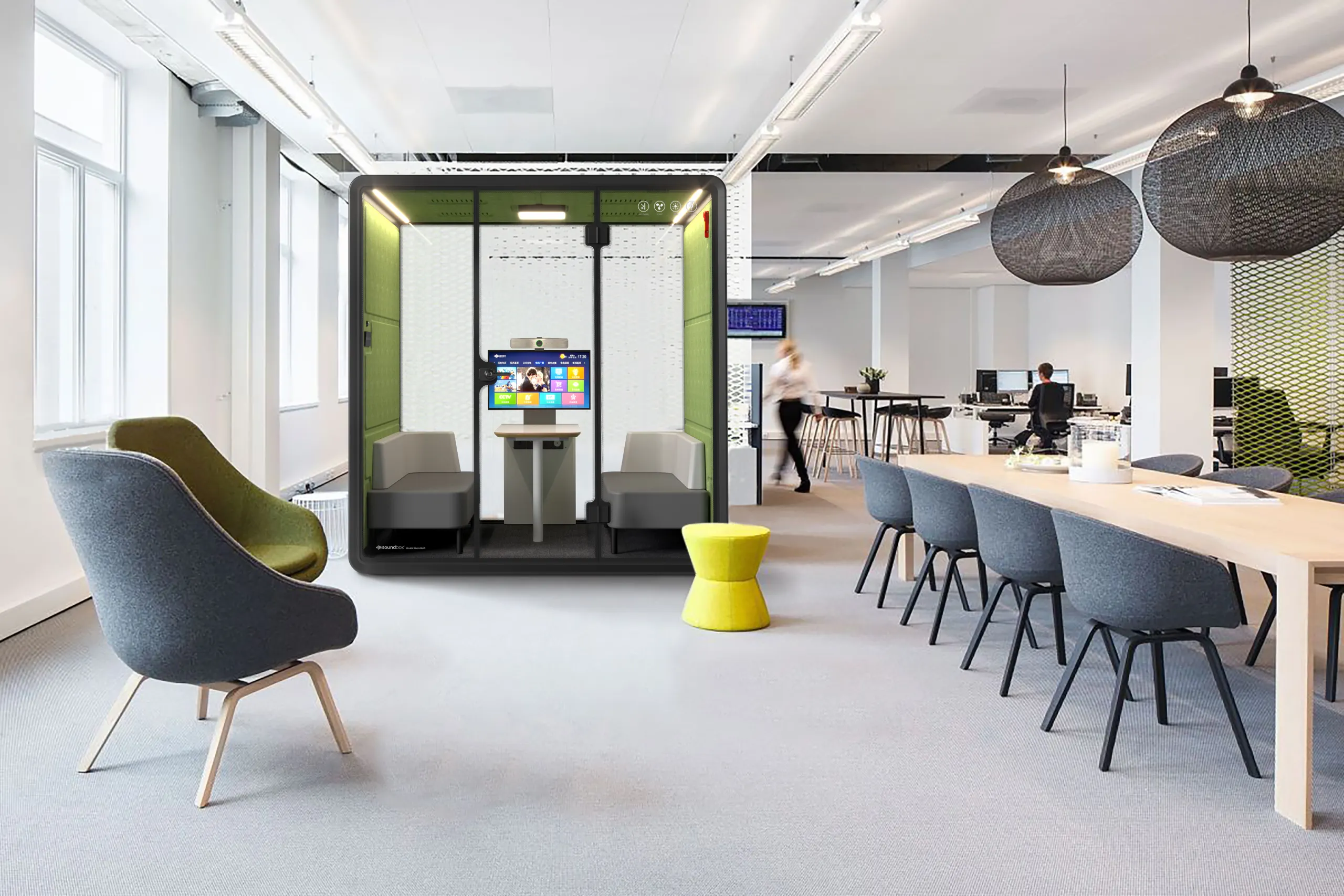
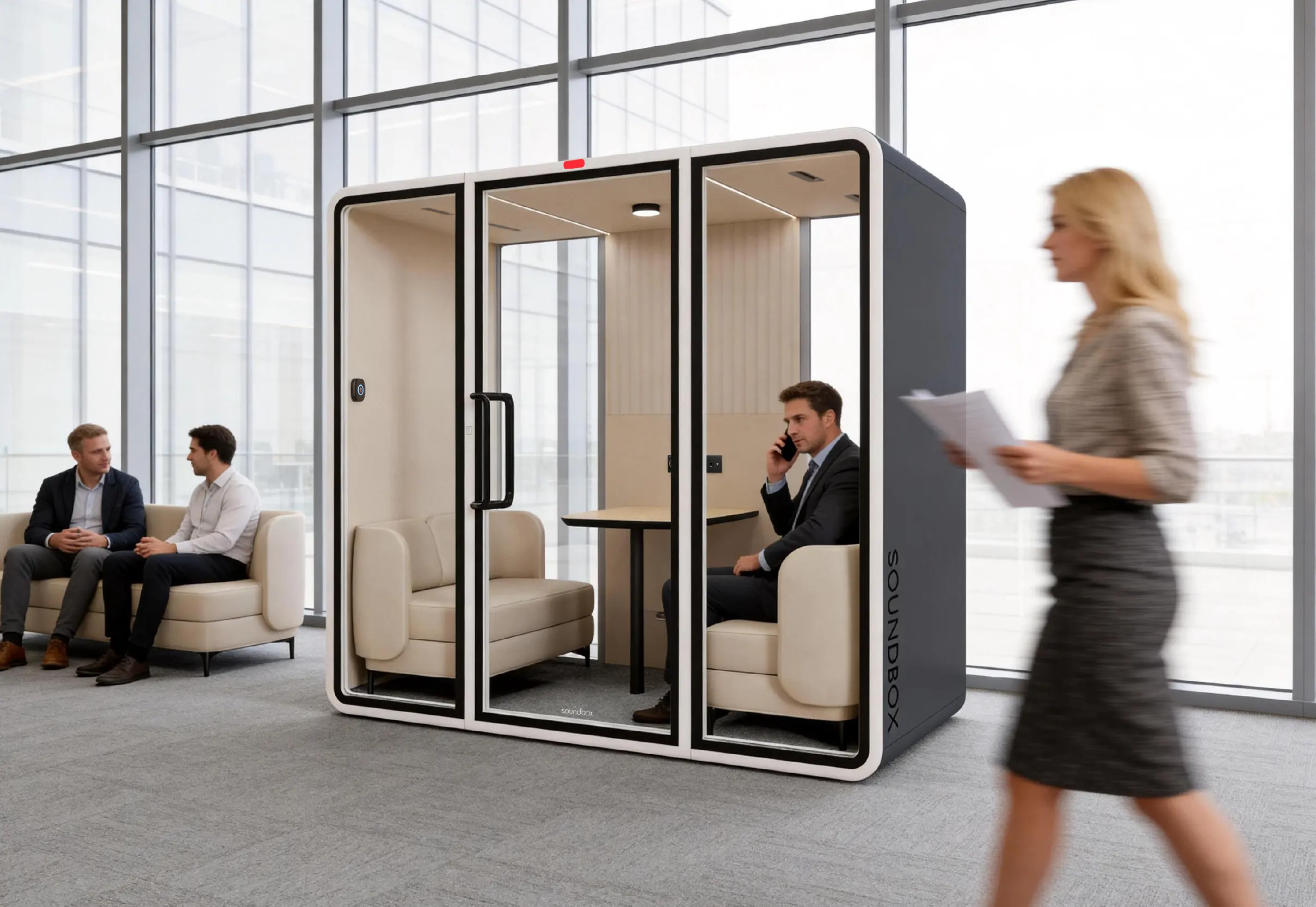
An office pod (also called an acoustic pod, office pod for open office, or soundproof office booth) is a freestanding, acoustically engineered enclosure that creates a quiet zone within an open-plan workspace. SoundBox pods achieve noise reduction through three mechanisms:
1. Acoustic Isolation
The pod’s walls, floor, and ceiling form a complete acoustic enclosure. SoundBox uses multi-layer construction:
- Carbon-plastic acoustic panels — denser and more consistent than traditional wood-based panels; resistant to moisture, mold, and warping
- PET sound-absorbing boards — trap mid- and high-frequency sounds within the wall assembly
- Damping floor coating — blocks vibration transmission through the base
- Sealed door system — magnetic or gasket-sealed doors prevent sound leakage at the most vulnerable point
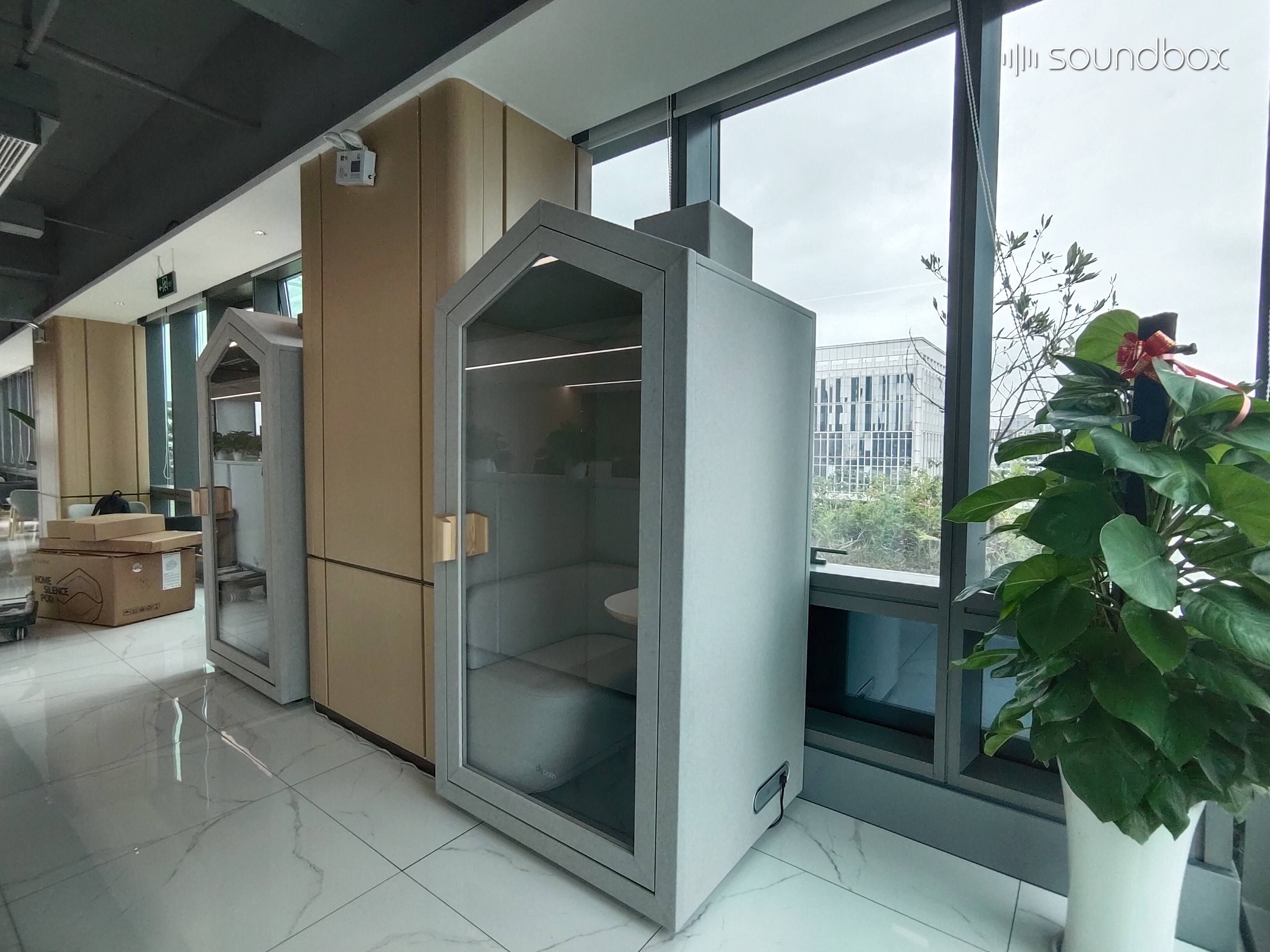
The result: ISO 23351-1 Class A certification with Ds.A values of 30.2–31.0 dB for ART series and approximately 30 dB for VRT series. This means a normal conversation at 60–65 dB outside the pod is reduced to approximately 30 dB inside — the level of a quiet library.
2. Internal Sound Absorption
Inside the pod, acoustic wall treatments absorb reflected sound, preventing echo and reverberation. This serves two purposes:
- Workers inside the pod hear crystal-clear audio for calls and video meetings (STI speech clarity index rated A+ at >0.76, approaching recording studio quality)
- Sound generated inside the pod is absorbed before it can escape
3. Ventilation Without Sound Leakage
A common concern with enclosed spaces is stale air. SoundBox addresses this with a **Panasonic ventilation system** featuring a hidden maze-pattern airflow channel. The maze design forces air through a series of turns that allow airflow while blocking sound transmission. The result is effective air exchange without compromising acoustic performance.
Material Safety
SoundBox pods use carbon-plastic panels rather than traditional plywood or MDF. This means:
- Near-zero formaldehyde (E0 level) per GB/T 18883-2002
- Zero benzene emissions
- No off-gassing of harmful volatile organic compounds
- The VRT series holds GREENGUARD Gold certification (No. 422773-420), meeting strict indoor air quality standards
- UL listed (E523389) and CE certified for electrical safety
Where to Place Pods in Your Open Plan Office
Strategic placement maximizes both usage rates and noise reduction across your floor plan. Here is a zone-based approach:
Zone 1: Call Zones (High Traffic, Short Duration)
- Location: Near workstations, elevator lobbies, or break area edges
- Purpose: Quick phone calls, video check-ins, private conversations (10–30 minutes)
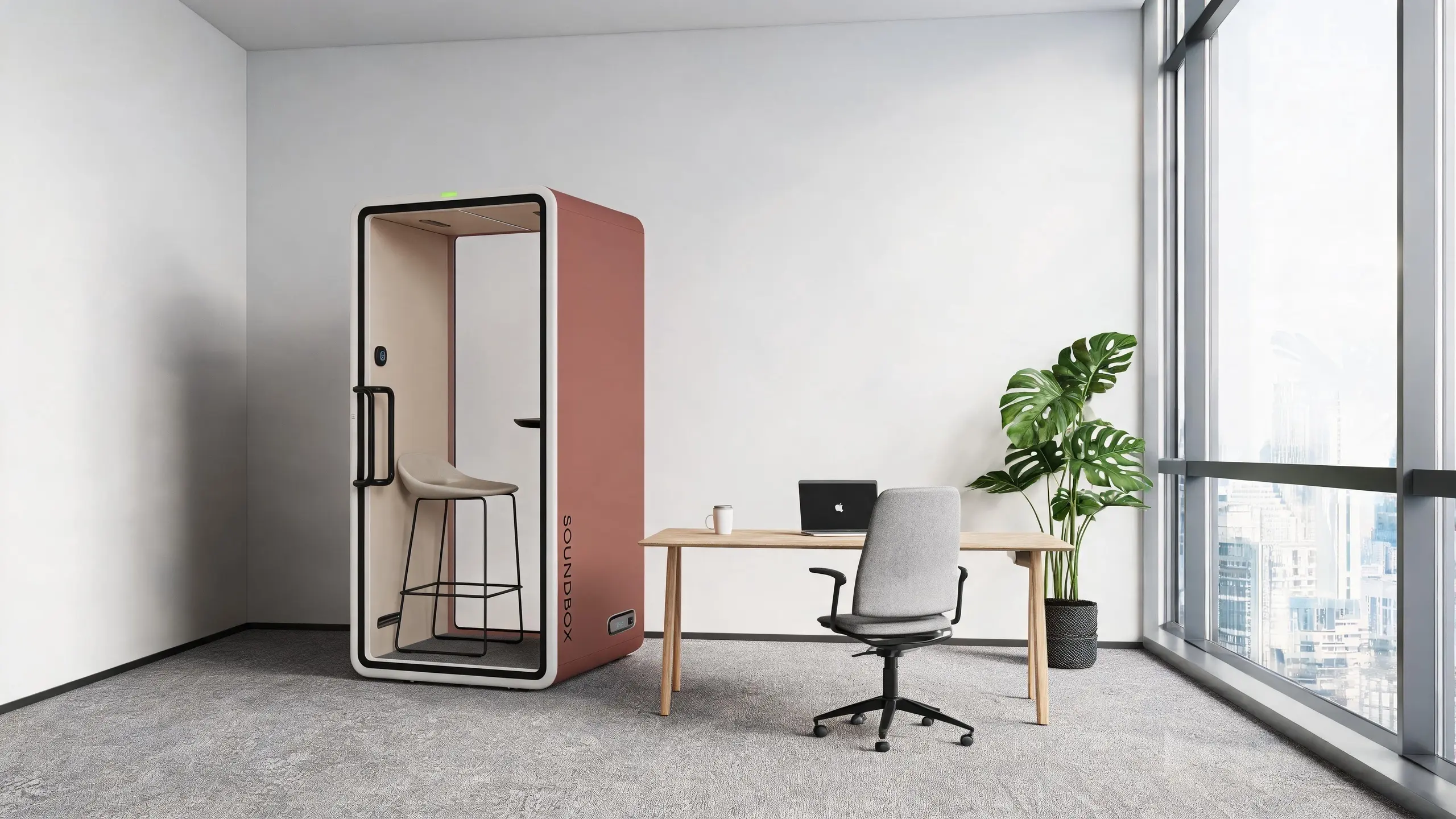
- Recommended models: 1-person pods (VRT S, ART S)
- Quantity guideline: 1 pod per 15–20 employees in open-plan areas
Zone 2: Focus Zones (Medium Traffic, Extended Use)
- Location: Corners or along window walls, away from main circulation paths
- Purpose: Deep work sessions, virtual meetings, heads-down tasks (1–3 hours)
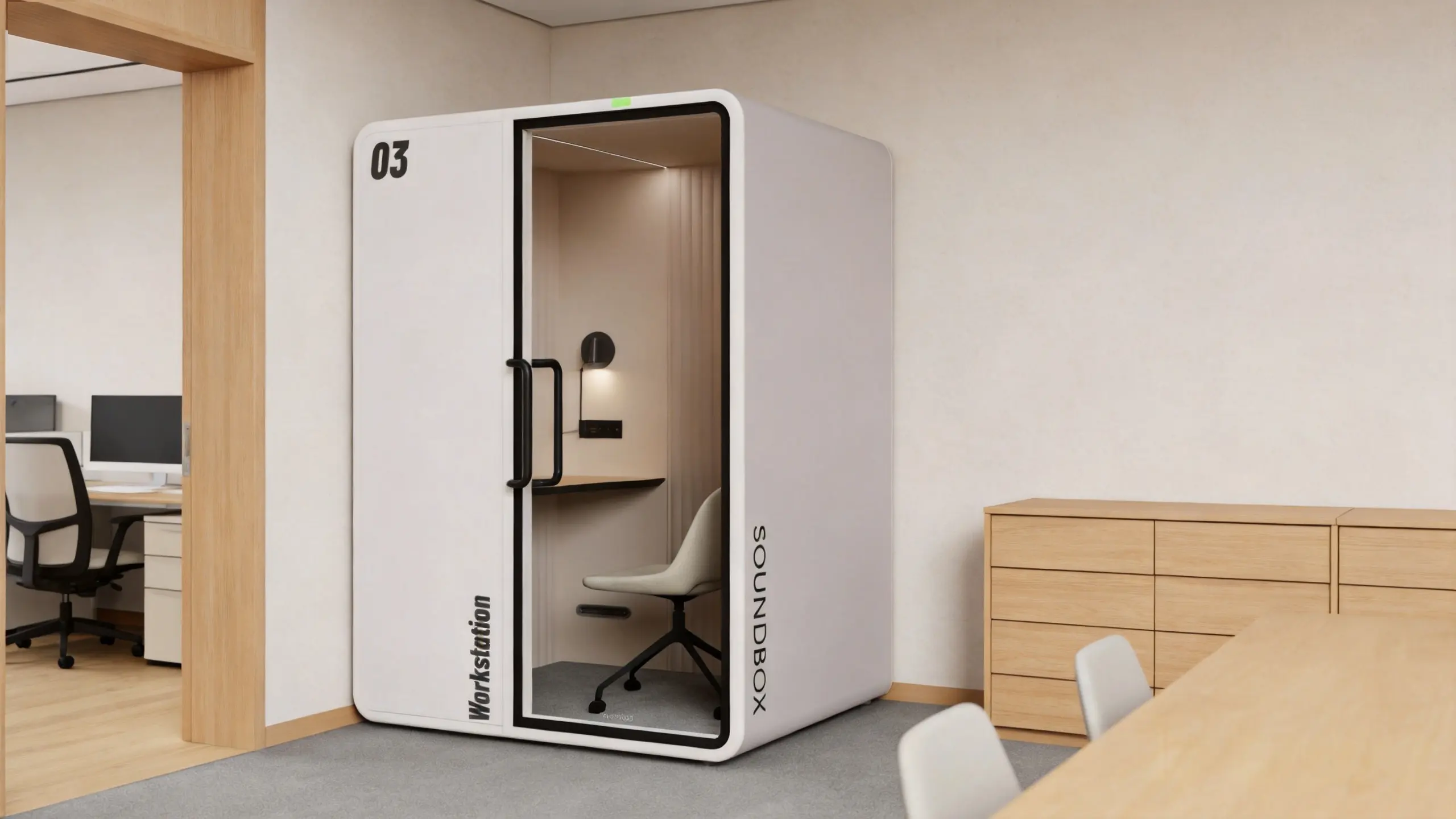
- Recommended models: 1-person pods with desk space (VRT SM, ART SM)
- Quantity guideline: 1 pod per 25–30 employees
Zone 3: Collaboration Zones (Lower Traffic, Group Use)
- Location: Central areas with clear sightlines, near team neighborhoods
- Purpose: Small team meetings, brainstorming, client calls (30–120 minutes)
- Recommended models: 2–4 person pods (VRT ML, ART ML)
- Quantity guideline: 1 pod per team or department cluster
Placement Tips
- Keep pods at least 1 meter from desk clusters to avoid visual obstruction
- Position pod doors away from main walkways to preserve privacy
- Ensure each pod has access to a standard 3-prong power outlet
- Use booking through the companion app to prevent queue conflicts
SoundBox Pod Recommendations by Office Zone
Call Zone: Compact 1-Person Pods
| Spec | VRT S | ART S |
|---|---|---|
| Capacity | 1 person | 1 person |
| Dimensions (W×D×H) | 1000×940×2100 mm | 1000×940×2100 mm |
| Acoustic rating | ISO 23351-1 Class A, ~30 dB | ISO 23351-1 Class A, 30.4 dB |
| Interior | Bench seat, shelf, ceiling light | Acoustic panels, bench seat, integrated lighting |
| Ideal for | Quick calls, private conversations | Quick calls, design-forward spaces |
| Ventilation | Panasonic maze airflow | Panasonic maze airflow |
| Price (USD) | $10,091 | $8,032 |
Focus Zone: Extended-Work 1-Person Pods
| Spec | VRT SM | ART SM |
|---|---|---|
| Capacity | 1 person | 1 person |
| Dimensions (W×D×H) | 1100×1040×2100 mm | 1100×1040×2100 mm |
| Acoustic rating | ISO 23351-1 Class A, ~30 dB | ISO 23351-1 Class A, 30.2 dB |
| Interior | Black door frame, bench seat, shelf | Ergonomic seat, workspace surface |
| Ideal for | Focused work, individual tasks | Extended concentration, deep work |
| Ventilation | Panasonic maze airflow | Panasonic maze airflow |
| Price (USD) | $11,121 | $9,061 |
Collaboration Zone: 2–4 Person Meeting Pods
| Spec | VRT ML | ART ML |
|---|---|---|
| Capacity | 2–4 persons | 2–4 persons |
| Dimensions (W×D×H) | 2200×1240×2100 mm | 2200×1240×2100 mm |
| Acoustic rating | ISO 23351-1 Class A, ~30 dB | ISO 23351-1 Class A, 30.6 dB |
| Interior | Glass panels, 2 ergonomic chairs, adjustable table | Acoustic panels, collaborative layout |
| Ideal for | Team meetings, video conferences | Creative sessions, brainstorming |
| Ventilation | Panasonic maze airflow | Panasonic maze airflow |
| Price (USD) | $16,269 | $13,180 |
VRT vs. ART at a glance: Both series achieve ISO 23351-1 Class A acoustic performance. VRT is the performance-oriented line with GREENGUARD Gold certification (VRT series, cert. 422773-420) and ASTM E90 tested models (VRT S and VRT L, reports OFFLM20251205-144A/147A). ART offers a design-forward aesthetic at a lower price point, with acoustic data per product specification sheets.
Additional Models Available
For larger meeting needs, the VRT L and ART L accommodate 4–6 persons with dimensions of 2200×1640×2100 mm, featuring three-panel glass enclosures, round tables, and curved armchairs.
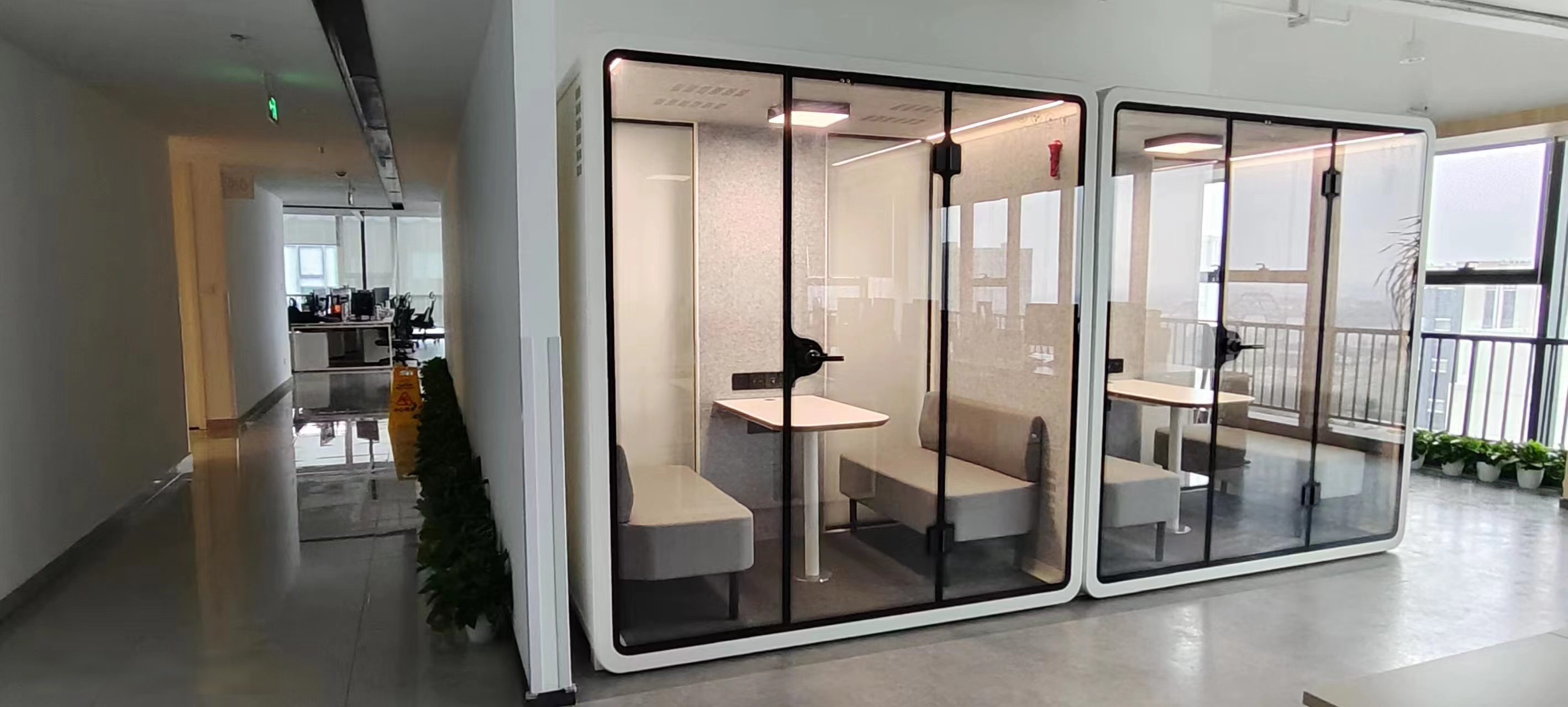
For standard individual workspaces, the VRT M and ART M provide full desk setups with drawer desks, swivel chairs, and comprehensive power connectivity.
ROI: The Business Case for Office Pods
Productivity Gains
Research suggests that reducing office noise distractions can improve individual productivity by an estimated 10–15%. For a team of 50 open-plan workers with an average salary of $60,000:
- Estimated annual productivity loss from noise: $300,000–$450,000 (assuming 10–15% lost time)
- Cost of 4 SoundBox ART S pods: ~$32,128
- Potential payback period: under 2 months of recovered productive time
These are estimated ranges based on industry benchmarks. Actual results vary by workplace, team composition, and pod utilization rates.
Space Savings Compared to Built Meeting Rooms
| Factor | Traditional Meeting Room | SoundBox Acoustic Pod |
|---|---|---|
| Construction cost | $15,000–$50,000+ | $8,032–$16,269 |
| Build time | 4–12 weeks | Approximately 4 hours (modular DIY) |
| Permits required | Often yes | No (freestanding) |
| Can be relocated | No | Yes |
| HVAC modification | Often needed | Not required |
| Renovation disruption | Significant | Minimal |
Flexibility and Scalability
Because SoundBox pods are freestanding and modular, they offer advantages that built spaces cannot:
- Reconfigure as your team grows: Move pods, add units, or change layouts without construction
- Support booking through companion app: Track usage data, manage reservations, optimize pod-to-employee ratios
- IoT remote monitoring: Monitor pod health, ventilation status, and utilization from a central dashboard
- NFC access: Tap-to-use functionality for seamless entry
- Lease-friendly: No permanent modifications to the space, ideal for rented offices
Environmental Credentials
SoundBox INC. brings 17 years of acoustic engineering expertise, with over 200 patents and a CNAS-accredited testing laboratory. The company operates a joint acoustic laboratory with Tsinghua University, featuring one of only three sub-zero decibel chambers in the world (designed to -21 dB at 30 meters underground).
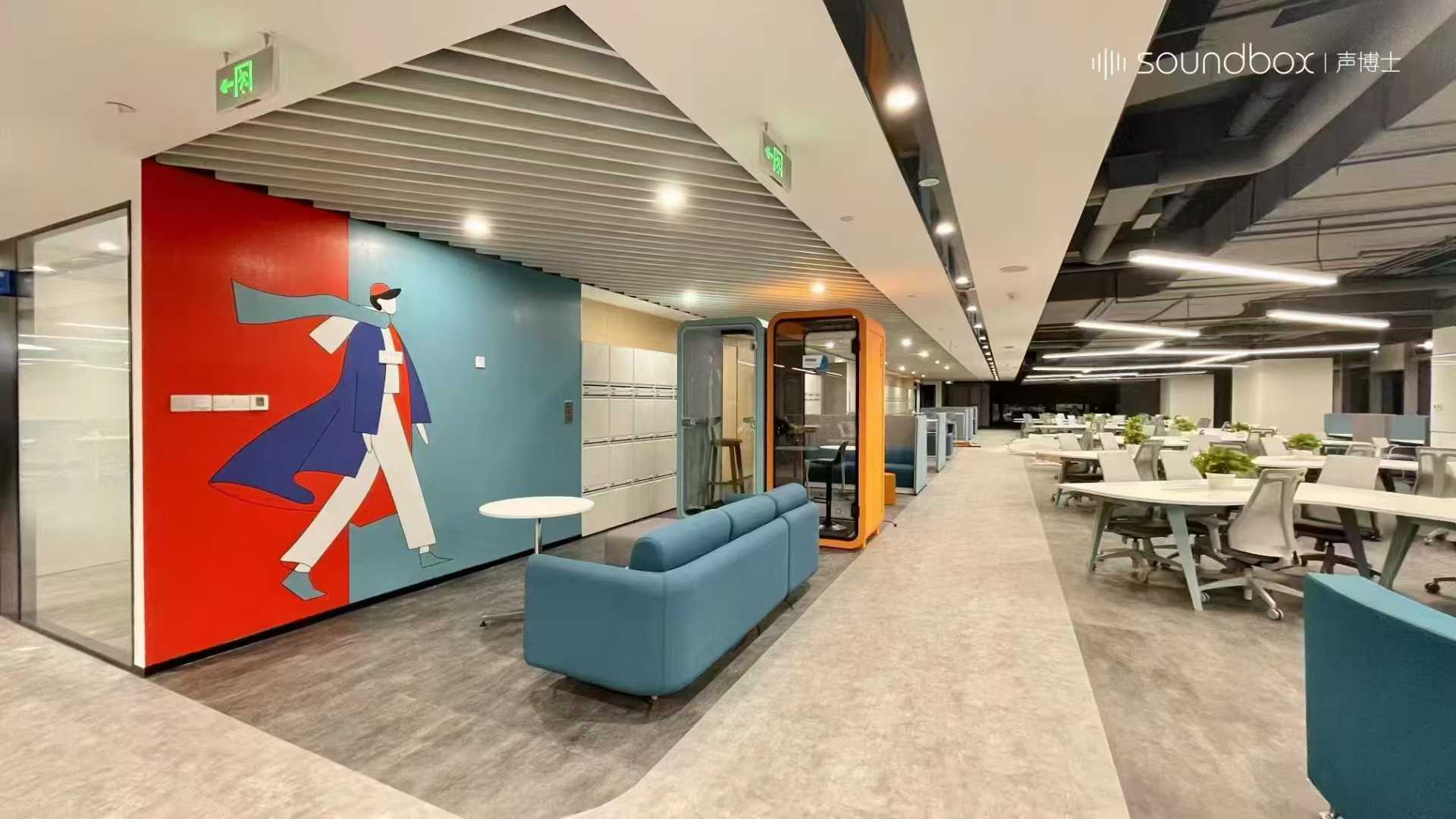
SoundBox has supplied acoustic products to enterprise clients including Tesla, Apple, Amazon, Boeing, United Airlines, Huawei, Alibaba, and ByteDance, and served as the acoustic assurance supplier for the 2022 Winter Olympics, 2023 Asian Games, and 2025 Asian Winter Games.
FAQ
How much noise do SoundBox acoustic pods block?
SoundBox pods achieve ISO 23351-1 Class A certification. The ART series delivers Ds.A values of 30.2–31.0 dB, and the VRT series delivers approximately 30 dB, per product specification sheets. This reduces a typical 60–65 dB office conversation to approximately 30 dB inside the pod — comparable to a quiet library. The VRT S and VRT L have additional ASTM E90 test reports (OFFLM20251205-144A and OFFLM20251205-147A).
Will I feel claustrophobic inside an office pod?
No. SoundBox pods feature a Panasonic ventilation system with a hidden maze-pattern airflow channel that provides effective air exchange while maintaining acoustic isolation. The interior height is 2170 mm (over 7 feet), and glass-panel models (VRT ML, VRT L, ART ML, ART L) provide natural light and visual openness.
How long does installation take?
SoundBox pods use modular DIY construction. Assembly takes approximately 4 hours with no special tools, no wet construction, and no permitting required. The pods are freestanding and require only a standard 3-prong power outlet.
Can acoustic pods be moved after installation?
Yes. SoundBox pods are freestanding units designed for modular assembly and disassembly. They can be relocated within an office or moved to a new space entirely. This makes them ideal for companies in leased spaces or those anticipating growth.
Are SoundBox pods safe and environmentally friendly?
SoundBox pods use carbon-plastic panels rather than traditional plywood, achieving near-zero formaldehyde (E0 level per GB/T 18883-2002) with zero benzene emissions. The VRT series holds GREENGUARD Gold certification (No. 422773-420). All models are UL listed (E523389) and CE certified. Pods use 304 stainless steel, aluminum profiles, and ABS engineering plastics for durability.
How do SoundBox pods compare to competitors on price?
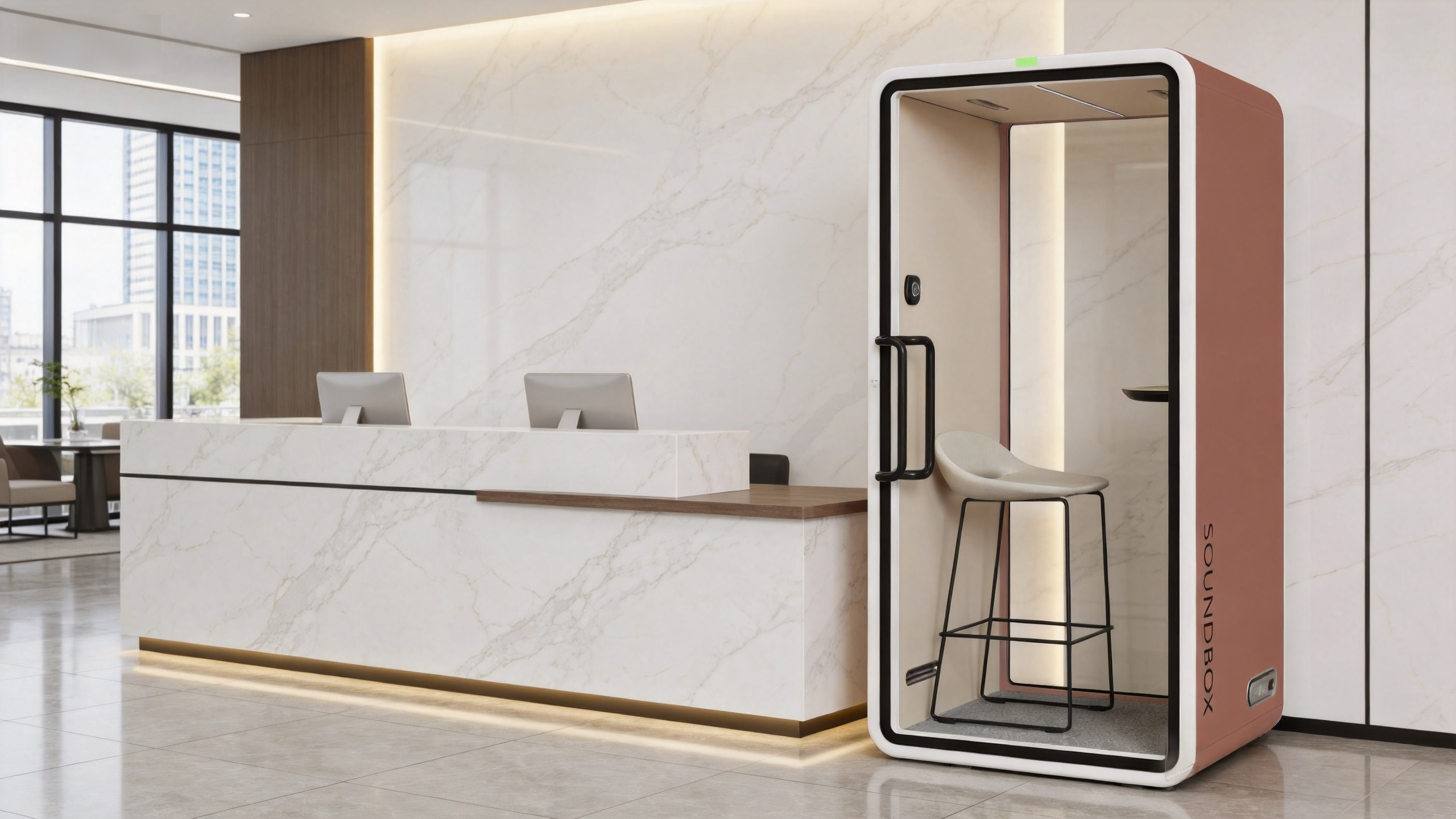
SoundBox occupies a mid-to-premium position. The ART S starts at $8,032 and the VRT S starts at $10,091. For comparison, the ROOM Phone Booth starts at $6,495 and the Framery One starts at approximately $15,000+ per publicly listed pricing as of 2026. SoundBox offers a broader model range (20+ models across VRT, VRT+, ART, ART+, and Home Pod series) with ISO 23351-1 Class A acoustic performance at competitive pricing.
Conclusion
Open-plan office noise is not a minor inconvenience — it is a measurable drag on productivity, employee satisfaction, and ultimately, business performance. Traditional solutions like white noise, headphones, and desk dividers treat symptoms. Acoustic pods treat the root cause.
SoundBox office pods for open office environments deliver ISO 23351-1 Class A noise reduction, Panasonic ventilation, modular installation, smart booking through a companion app, and a model range that scales from individual call booths to 6-person meeting spaces. Backed by 17 years of acoustic engineering, 200+ patents, and a CNAS-accredited laboratory, SoundBox provides a complete open plan office solution that is lab-tested, certifiably safe, and ready to install in approximately 4 hours.
Ready to reclaim your office from noise? Explore SoundBox office pods to find the right model for your workspace, or contact our team for a personalized recommendation based on your floor plan and team size.