Soundproof Office Pod Specs: Acoustic Ratings & Materials
Open-plan offices are significantly louder than recommended levels for concentration, according to research published in the *Journal of Environmental Psychology* and other workplace acoustic studies. The result is a measurable drop in cognitive performance, verbal recall, and task accuracy — not a subjective complaint, but a documented physiological response.
A soundproof office pod addresses this by creating an isolated acoustic envelope inside the open floor plan. But “soundproof” is not a regulated term in most markets. Two pods marketed identically can deliver a 20 dB difference in real-world noise reduction. The only way to compare them is through standardized testing — and that means understanding the numbers behind the marketing.
This guide breaks down what makes an office pod genuinely soundproof: the acoustic science, the test methods, the materials, and the specific performance data for SoundBox’s VRT, ART, and ART+ product lines.
What Makes an Office Pod “Soundproof”
Sound travels as mechanical pressure waves through air and solid structures. When a pod blocks outside noise, it does so through three mechanisms:
- Mass — Heavy materials resist vibration. Denser walls absorb more acoustic energy before it passes through.
- Decoupling — Creating an air gap or mechanical break between inner and outer surfaces prevents structural transmission. Sound energy that enters the outer wall cannot efficiently transfer across the gap.
- Absorption — Porous materials inside the cavity (and on interior surfaces) convert sound energy into tiny amounts of heat through friction. PET felt, acoustic foam, and mineral wool all work this way.
A well-engineered pod combines all three. The outer shell provides mass. The wall cavity provides decoupling. The interior lining provides absorption. Skip any one, and performance drops significantly — a pod with heavy walls but no internal absorption, for example, will suffer from reverberation (echo) inside, making speech unintelligible even though outside noise is reduced.
The goal is not silence — that would require an anechoic chamber. The goal is speech privacy: reducing noise levels enough that conversations inside the pod cannot be understood outside, and distracting office noise does not intrude.
Sound Reduction Ratings: dB, ISO 23351-1, and ASTM E90
Decibels (dB) and What They Mean
Sound reduction is measured in decibels. Because the dB scale is logarithmic, the perceptual effect is not linear:
| dB Reduction | Perceived Effect |
|---|---|
| 10 dB | Sounds half as loud |
| 20 dB | Sounds one-quarter as loud |
| 25 dB | Normal speech drops to near-whisper level |
| 30 dB | Sounds one-eighth as loud |
| 35 dB | Loud speech becomes barely audible |
| 40 dB | Loud speech is inaudible |
A 30 dB reduction means a typical open-office ambient level of 65 dB drops to roughly 35 dB inside the pod — well below the threshold where speech is intelligible through the barrier. Normal conversational speech at 60 dB drops to approximately 30 dB, which is whisper-quiet. This is the level at which speech privacy is effectively achieved: bystanders may detect that someone is speaking, but cannot make out words or content.
ISO 23351-1: The Office Pod Acoustic Standard
ISO 23351-1 is the international standard specifically designed for measuring speech privacy in furniture ensembles and office pods. It measures the speech level reduction (Ds.A) — how much speech sound energy is reduced from inside the pod to outside. The standard assigns performance classes:
| Class | Ds.A Range | Speech Privacy Level |
|---|---|---|
| Class A | ≥ 30 dB | Highest — loud speech not intelligible outside |
| Class B | 25–29 dB | High — normal speech barely audible |
| Class C | 20–24 dB | Moderate — loud speech audible but unclear |
| Class D | < 20 dB | Basic — limited speech privacy |
Class A under ISO 23351-1 is the benchmark for environments where speech privacy is critical — HR conversations, executive calls, healthcare settings, and legal consultations.
STC (Sound Transmission Class)
STC is a single-number rating derived from ASTM E90 laboratory testing. It measures how effectively a wall or partition blocks airborne sound at frequencies from 125 Hz to 4000 Hz. Higher STC values indicate better sound isolation.
Key STC benchmarks:
| STC Rating | Speech Perception Through Barrier |
|---|---|
| 25 | Normal speech understood clearly |
| 30 | Loud speech understood fairly well |
| 35 | Loud speech audible but not intelligible |
| 40 | Loud speech barely audible |
| 45 | Loud speech not audible |
The ASTM E90 Test Method
ASTM E90 is the American standard for laboratory measurement of airborne sound transmission loss through building partitions. The test places the specimen between two reverberation rooms — a source room and a receiving room. A broadband noise source generates sound on one side, and microphones measure the sound level difference at 16 standard frequency bands (from 100 Hz to 5000 Hz).
This is the most rigorous and widely recognized test for office pod acoustic performance. SoundBox subjects its products to this standard, with test reports conducted by accredited laboratories.
SoundBox holds ASTM E90 acoustic test reports for its pod models, including report numbers OFFLM20251205-144A(VRT S) and OFFLM20251205-147A (VRT L), documenting verified sound transmission loss performance across the full frequency spectrum.
SoundBox Acoustic Performance by Product Line
SoundBox offers 20+ models across three product lines, each designed for different use cases and budget ranges. The VRT and ART series both achieve ISO 23351-1 Class A certification. The ART+ series provides a cost-effective entry tier with Class B-C acoustic performance.
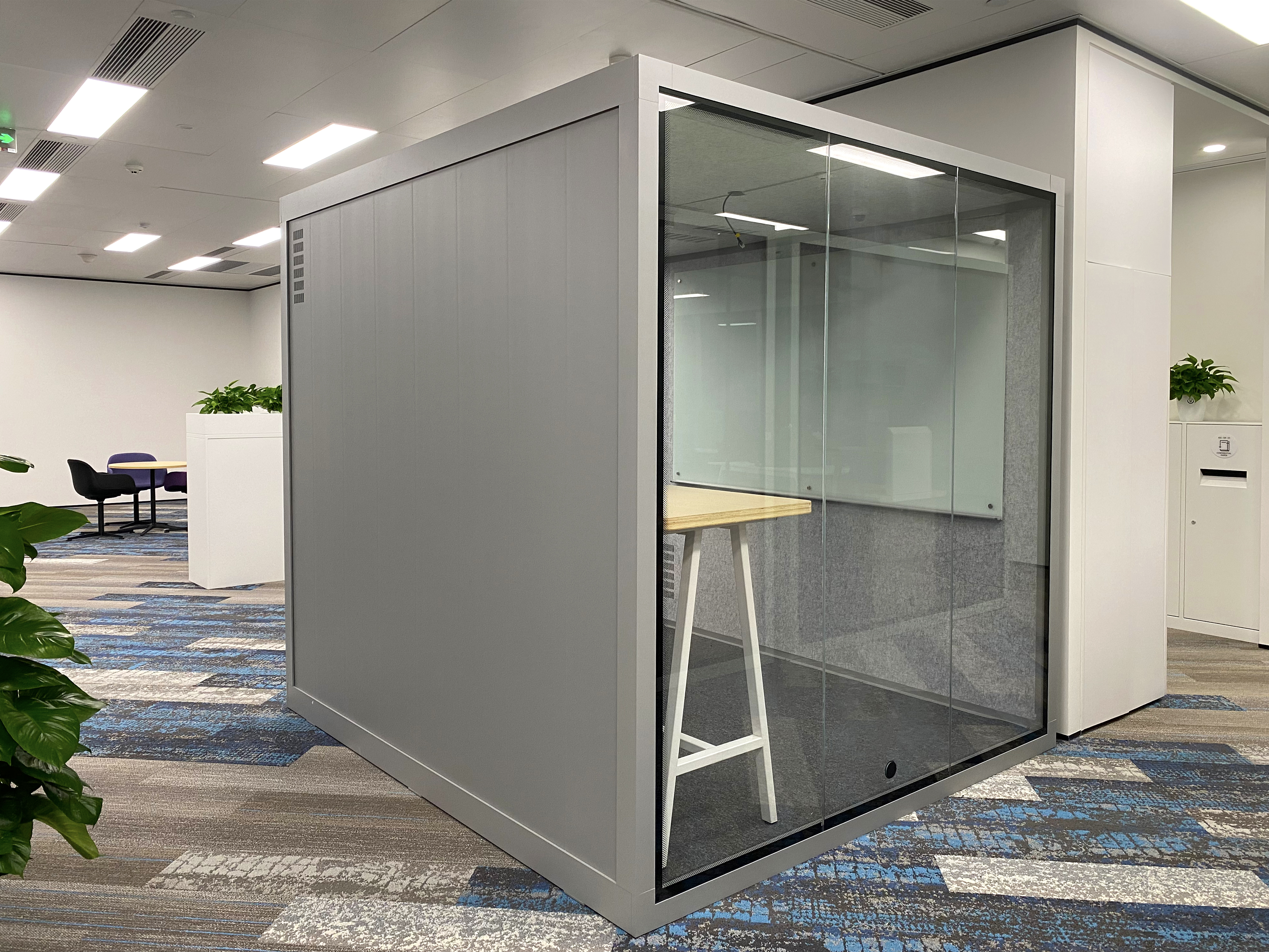
Product Line Comparison
| Specification | VRT Series | ART Series | ART+ Series |
|---|---|---|---|
| Acoustic Standard | ISO 23351-1, Class A | ISO 23351-1, Class A | ISO 23351-1, Class B-C |
| Ds.A (Speech Level Reduction) | ~30 dB | 30.2–31.0 dB | 23.8–27.0 dB |
| Capacity Range | 1–6 persons | 1–6 persons | 1–6 persons |
| Certifications | GREENGUARD Gold, UL, CE, ASTM E90 | UL, CE, ISO 23351-1 | UL, CE |
| Interior | Premium finishes, Panasonic ventilation | Design-forward, multiple color options | Carbon-plastic panels, streamlined design |
| Installation | Freestanding | Freestanding | Freestanding |
| Assembly | Modular DIY (~4 hours) | Modular DIY (~4 hours) | Modular DIY (~4 hours) |
| Positioning | Premium: highest-grade finishes | Professional: Class A at best value | Entry: cost-effective acoustic privacy |
The VRT series holds GREENGUARD Gold certification (422773-420) for indoor air quality and has been tested to ASTM E90 standards (reports OFFLM20251205-144A/147A) — a distinction that matters in enclosed occupied spaces where material emissions directly affect occupant health.
The ART series delivers the same ISO 23351-1 Class A acoustic certification as the VRT series, with specific Ds.A values verified by independent test reports for each model.
The ART+ series uses carbon-plastic panels for cost efficiency, achieving ISO 23351-1 Class B or Class C acoustic performance — suitable for general office environments where moderate speech privacy is sufficient.
ART Series: Detailed Acoustic Data (ISO 23351-1 Class A)
Each ART model has been independently tested per ISO 23351-1 (report numbers per manufacturer spec sheet):
| Model | Ds.A | ISO 23351-1 Class | Test Report |
|---|---|---|---|
| ART S | 30.4 dB | Class A | OFFLM20251231-159A |
| ART SM | 30.2 dB | Class A | OFFLM20260116-007A |
| ART M | 30.3 dB | Class A | OFFLM20260121-016A |
| ART ML | 30.6 dB | Class A | OFFLM20260119-010A |
| ART L | 31.0 dB | Class A | OFFLM20260121-013A |
All ART models meet or exceed 30 dB Ds.A — matching the acoustic benchmark set by the category leader Framery (30 dB, ISO 23351-1 Class A). The ART L achieves the highest Ds.A in the lineup at 31.0 dB, providing the strongest speech privacy for larger meeting configurations.
ART+ Series: Detailed Acoustic Data (ISO 23351-1 Class B-C)
| Model | Ds.A | ISO 23351-1 Class |
|---|---|---|
| ART+ S | 25.1 dB | Class B |
| ART+ SM | 26.4 dB | Class B |
| ART+ M | 23.8 dB | Class C |
| ART+ ML | 27.0 dB | Class B |
| ART+ L | 25.1 dB | Class B |
The ART+ series delivers Class B performance across most models, with the ART+ ML achieving 27.0 dB — approaching Class A territory. This makes ART+ a practical choice for open-plan offices where budget is a primary constraint but acoustic comfort still matters.
Model Pricing Reference
| Model | Series | Capacity | Starting Price (USD) |
|---|---|---|---|
| ART S | ART | 1 person | $8,032 |
| ART SM | ART | 1 person | $9,061 |
| VRT S | VRT | 1 person | $10,091 |
| VRT SM | VRT | 1 person | $11,121 |
| ART M | ART | 1 person | $11,121 |
| VRT M | VRT | 1 person | $13,180 |
| ART ML | ART | 2–4 persons | $13,180 |
| VRT ML | VRT | 2–4 persons | $16,269 |
| ART L | ART | 4–6 persons | $15,240 |
| VRT L | VRT | 4–6 persons | $18,329 |
The ART series delivers ISO 23351-1 Class A acoustic performance (30.2–31.0 dB Ds.A) at a lower price point than the VRT series, making it the best value for speech privacy. The VRT series commands a premium for its GREENGUARD Gold certification, higher-grade interior finishes, and expanded capacity options. The ART+ series provides the most accessible entry point for organizations prioritizing budget.
Materials and Construction
Carbon-Plastic Panel System
SoundBox pods use a proprietary carbon-plastic composite for the primary wall panels. This material was selected for three properties:
- High mass-to-thickness ratio — Dense enough to block sound transmission without requiring excessively thick walls, preserving interior space.
- Structural rigidity — Panels maintain flatness and seal integrity over years of use, preventing acoustic leaks from developing at joints.
- Zero off-gassing — The material meets the E0 emissions standard under GB/T 18883-2002 (China’s indoor air quality standard), with zero benzene detected. This matters because pods are small enclosed spaces where volatile organic compound (VOC) accumulation directly affects air quality during extended use.
This is a deliberate departure from the plywood and MDF panels used by many competing pod manufacturers. Those materials are manufactured with formaldehyde-based adhesives that continue to off-gas for months or years. In a 2 m x 2 m enclosed space, that off-gassing directly affects the air the occupant breathes during every call, meeting, or focus session.
PET Acoustic Absorption
Interior surfaces use PET (polyethylene terephthalate) felt panels for sound absorption. PET is widely specified in architectural acoustics because it:
- Absorbs mid- and high-frequency reflections (the frequencies most relevant to speech)
- Is durable and maintains its absorption coefficient over time
- Is recyclable and meets low-VOC emission standards
DIY Modular Assembly
Each pod ships as six modular components that assemble without professional tools or specialized acoustic caulking. Average assembly time is approximately 4 hours for two people. The modular design means:
- Pods can be disassembled and relocated without acoustic degradation
- No on-site construction waste or wet trades (adhesive, sealant)
- Acoustic seals are built into the panel joints at the factory, not field-applied
This is a significant advantage over built-in acoustic rooms, which require specialist contractors for installation and cannot be moved without substantial reconstruction — and over competing pods that require professional installation teams, adding cost and scheduling complexity.
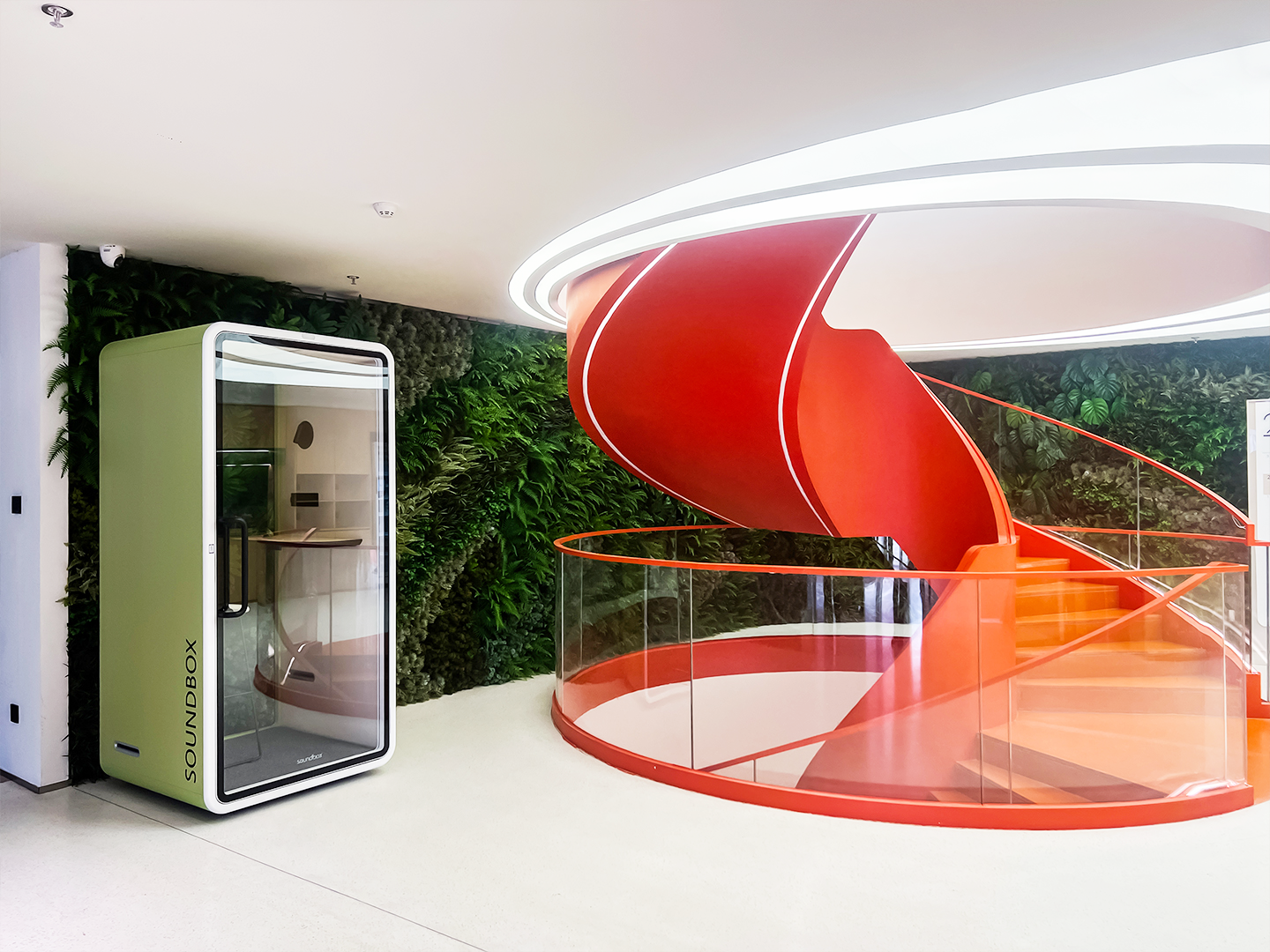
Ventilation Without Sound Leakage
Ventilation is the most common acoustic failure point in office pods. Air must flow in and out, but sound travels through the same openings. Most pods solve this by using narrow ducts and bends to attenuate sound — but this restricts airflow, leading to poor air quality inside.
SoundBox addresses this with a hidden maze airflow design, engineered in partnership with Panasonic.
How the Maze Airflow Works
The ventilation path uses a series of internal baffles arranged in a labyrinth pattern. Sound waves must navigate multiple 90-degree turns and pass through absorptive surfaces at each bend. At each turn, sound energy is reflected and absorbed, while air — which does not propagate as directional waves — flows freely.
This allows the system to achieve:
- Rapid air exchange — The Panasonic fan moves sufficient volume to replace the air inside the pod within accepted ventilation standards for small occupied spaces.
- No acoustic flanking — The maze path provides equivalent sound attenuation to a solid wall at the ventilation opening. Sound does not bypass the pod’s acoustic envelope through the air duct.
The Panasonic ventilation unit is integrated into the pod’s ceiling structure, with the intake and exhaust paths both routed through the maze system. This is a fundamentally different approach from simple grill-and-fan designs, where the ventilation opening is a direct acoustic weak point.
Smart Features
NFC Access Control
Each pod is equipped with an NFC reader. Employees tap their phone or NFC card to unlock the pod door. This enables:
- Usage tracking per individual or department
- Access restriction for reserved time slots
- Integration with corporate identity systems
Smart Booking App
A companion mobile application allows users to check pod availability in real time and reserve time slots. The booking system prevents conflicts and ensures equitable access in shared office environments.
Cloud Management Platform
Facility managers can monitor all pods from a centralized cloud dashboard:
- Real-time occupancy status
- Historical usage analytics
- Ventilation system health monitoring
- Firmware updates pushed remotely
This IoT infrastructure is built into every pod at no additional cost — it is not an aftermarket add-on.
Certification Overview
SoundBox pods carry certifications from internationally recognized testing bodies. These are not self-declarations; each certification required independent laboratory verification.
Acoustic Testing
| Certification | Details |
|---|---|
| ISO 23351-1, Class A | VRT and ART series certified for speech level reduction. VRT: ~30 dB Ds.A. ART: 30.2–31.0 dB Ds.A (model-specific test reports available) |
| ASTM E90 | Airborne sound transmission loss tested per ASTM E90 standard. Test reports: OFFLM20251205-144A (VRT S), OFFLM20251205-147A (VRT L) |
| CNAS Lab Accreditation | SoundBox’s own acoustic testing center is CNAS-accredited (China National Accreditation Service) |
| MA Certification | Measurement accreditation for acoustic testing |
Safety and Environmental
| Certification | Details |
|---|---|
| UL E523389 | Underwriters Laboratories safety certification for electrical components and construction |
| CE | European conformity marking for sale in EU markets |
| GREENGUARD Gold 422773-420 | UL-certified for low chemical emissions, meeting the stricter GREENGUARD Gold standard for sensitive environments (schools, healthcare). VRT series. |
| E0 Emissions (GB/T 18883-2002) | Zero formaldehyde emission classification under China’s indoor air quality standard, with zero benzene detected |
Acoustic Testing Infrastructure
SoundBox operates its own acoustic testing center, equipped with Danish Bruel & Kjaer (B&K) instrumentation — the industry standard for precision acoustic measurement. The facility includes an underground anechoic chamber rated to -21 dB noise floor, developed in collaboration with Tsinghua University. This chamber allows measurement of extremely low-level sound signals that would be masked by ambient noise in standard test facilities.
SoundBox holds over 200 patents in acoustic engineering and is the only Asian manufacturer included in the German EASE (Enhanced Acoustic Simulator for Engineers) acoustic software database — a tool used by acoustic consultants worldwide to model room acoustics and specify materials.
The company was founded in 2008, bringing 17 years of specialized acoustic experience to the office pod market. This is not a furniture company that added acoustic panels to a booth; it is an acoustics company that designed a pod from the sound outward.
How SoundBox Compares to Market Alternatives
When evaluating soundproof office pods, the comparison cannot be reduced to a single dB number. The meaningful differences lie in testing depth, material safety, product range, and overall value. Here is how SoundBox positions against the market.
Acoustic Performance: Matching the Category Leader
The critical benchmark in the office pod market is Framery, which holds ISO 23351-1 Class A certification with a 30 dB Ds.A rating. SoundBox’s acoustic data:
| Series | Ds.A | ISO 23351-1 Class | vs. Framery (30 dB) |
|---|---|---|---|
| SoundBox ART | 30.2–31.0 dB | Class A | Matches or exceeds |
| SoundBox VRT | ~30 dB | Class A | Matches |
| Framery | 30 dB | Class A | Reference benchmark |
| SoundBox ART+ | 23.8–27.0 dB | Class B-C | Entry tier |
SoundBox ART and VRT series achieve the same ISO 23351-1 Class A certification as Framery, with the ART series actually exceeding Framery’s 30 dB across all models (ART S: 30.4 dB, ART ML: 30.6 dB, ART L: 31.0 dB). Each ART model carries its own independent test report with a verifiable report number.
Testing Depth and Transparency
Most office pod manufacturers rely solely on third-party laboratories for final certification testing. This is valid but limited — it produces a snapshot of one unit at one point in time.
SoundBox operates its own CNAS-accredited testing center with B&K instrumentation and a -21 dB underground anechoic chamber (co-developed with Tsinghua University). This means acoustic performance is measured and validated at every stage — material selection, prototype iteration, and final production — not just at certification.
The result: SoundBox publishes test reports with specific report numbers for each ART model (per product specification sheets) and makes them available to buyers.
SoundBox is also the only Asian manufacturer included in the EASE (Enhanced Acoustic Simulator for Engineers) database — the acoustic simulation software used by consultants worldwide to design concert halls, broadcast studios, and critical listening environments.
Material Emissions and Indoor Air Quality
A pod is a small enclosed space. What its materials emit into the air matters as much as what its walls block from outside. Many office pods — including premium brands — use plywood or MDF for desktop surfaces and interior panels. These materials are manufactured with formaldehyde-based adhesives that continue to off-gas for months or years after production.
SoundBox uses a carbon-plastic composite for its structural panels, eliminating formaldehyde-based adhesives entirely. Interior acoustic treatment uses PET absorption panels and polyester fabric — thermoplastic materials that do not require volatile solvent binders. The VRT series holds GREENGUARD Gold certification (422773-420), confirming emissions meet the strict CA Section 01350 standard required for schools and healthcare environments. E0 emissions compliance under GB/T 18883-2002 confirms near-zero formaldehyde levels with zero benzene detected.
This is not a minor specification. In a 2 m x 2 m enclosed pod occupied for hours of calls and focused work, material off-gassing has a direct, measurable impact on the air the occupant breathes.
Product Range: 20+ Models Across Three Tiers
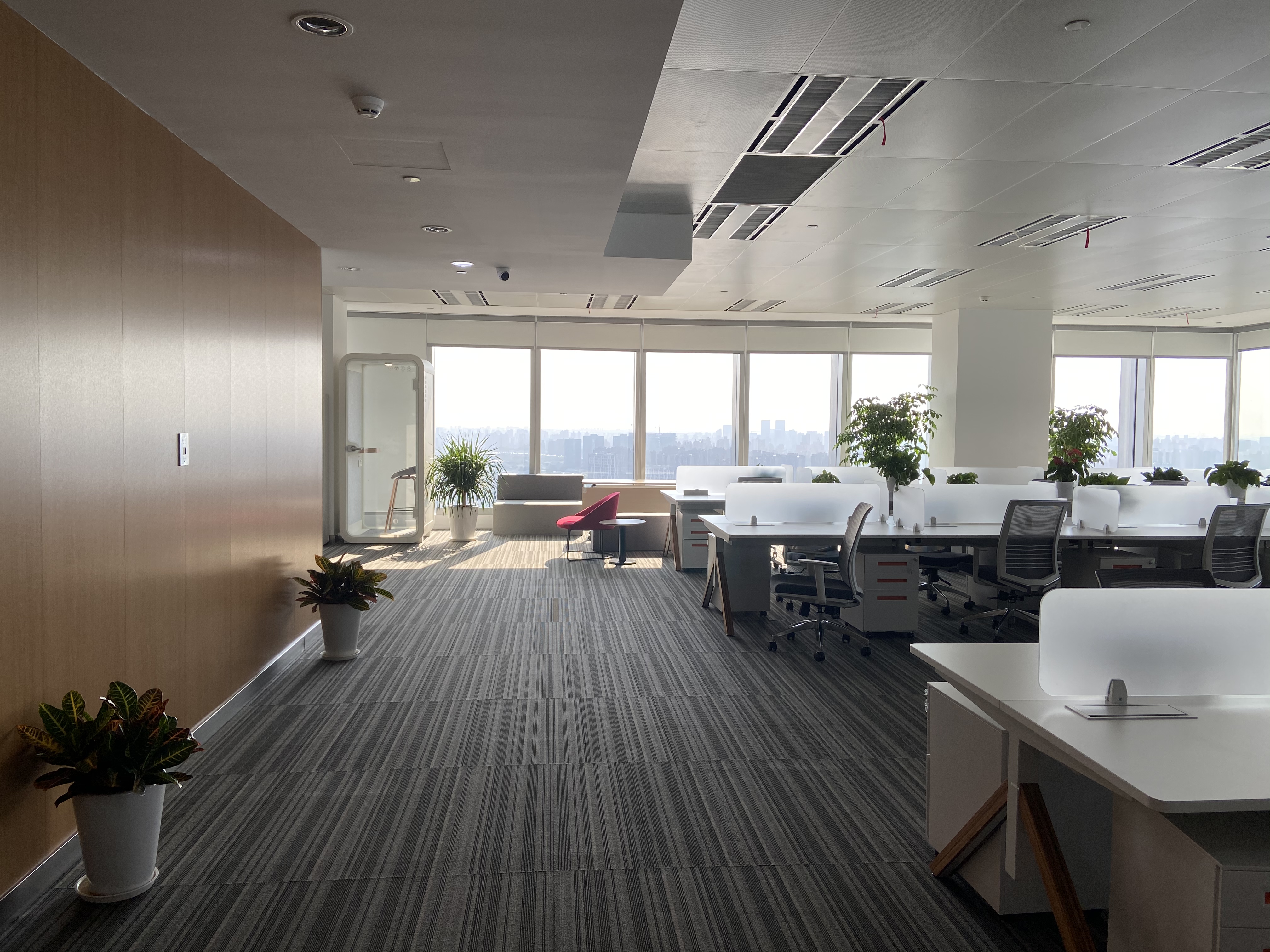
The office pod market is dominated by brands offering a handful of models in narrow size ranges. SoundBox offers **20+ models across three product lines** spanning 1-person phone booths to 6-person meeting rooms:
| Series | Capacity | Acoustic Class | Positioning |
|---|---|---|---|
| VRT | 1–6 persons | Class A (~30 dB) | Premium: GREENGUARD Gold, full-size meeting rooms |
| ART | 1–6 persons | Class A (30.2–31.0 dB) | Professional: Class A at best value |
| ART+ | 1–6 persons | Class B-C (23.8–27.0 dB) | Entry: cost-effective acoustic privacy |
This breadth matters for organizations that need consistent acoustic performance and management across different space types — from individual focus pods to 6-person team meeting rooms — without mixing brands, control systems, or maintenance protocols.
Price-to-Performance Position
| Product | Capacity | Acoustic Class | Starting Price (USD) |
|---|---|---|---|
| SoundBox ART S | 1 person | Class A (30.4 dB) | $8,032 |
| SoundBox VRT S | 1 person | Class A (~30 dB) | $10,091 |
| Framery One Compact | 1 person | Class A (30 dB) | ~$9,690 |
| Framery One | 1 person | Class A (30 dB) | ~$13,090 |
SoundBox delivers ISO 23351-1 Class A acoustic performance at a competitive price point. The ART S at $8,032 undercuts the Framery One Compact ($9,690) while achieving 30.4 dB Ds.A — exceeding Framery’s 30 dB benchmark. This means organizations can get Class A speech privacy at a lower cost per unit.
For larger configurations, SoundBox scales up to 6-person meeting rooms (ART L at $15,240, 31.0 dB Ds.A) — a capacity range that most competing brands do not address.
Where SoundBox Stands Apart
Four capabilities that differentiate SoundBox from other acoustic pod manufacturers:
- ISO 23351-1 Class A across VRT and ART lines. Not just claimed, but independently certified with specific Ds.A values and test report numbers for each model. The ART series (30.2–31.0 dB) matches or exceeds the category benchmark.
- Own testing infrastructure. A CNAS-accredited lab with B&K instrumentation and a -21 dB anechoic chamber means SoundBox can verify acoustic claims at every stage — not just for final certification, but during R&D, material selection, and design iteration.
- Material safety. Carbon-plastic panels with near-zero formaldehyde (E0 level), GREENGUARD Gold certification (VRT series), and E0 emissions. No plywood, no MDF, no off-gassing adhesives. This is a health specification, not a cosmetic one.
- Product breadth. 20+ models from 1-person phone booths to 6-person meeting rooms, three product tiers (VRT, ART, ART+), all manageable from a single cloud platform. One vendor for the full office acoustic strategy.
Lighting
Interior lighting uses Ra97 high-CRI (Color Rendering Index) LED fixtures at a 4000K color temperature. The significance:
- CRI 97 — Colors appear nearly identical to natural sunlight. This matters for video calls, where lower CRI lighting makes skin tones look washed out or unnatural. Most office lighting achieves CRI 80–85.
- 4000K — Neutral white, perceived as natural daylight. Not the cold blue of 5000K+ (which disrupts circadian rhythm) and not the warm yellow of 3000K (which causes drowsiness). 4000K is the standard specification for task lighting in ergonomic workplace guidelines.
FAQ
How many decibels does a soundproof office pod reduce?
SoundBox VRT and ART pods are certified to ISO 23351-1 Class A, with Ds.A (speech level reduction) values of 30.2–31.0 dB for the ART series and ~30 dB for the VRT series. To put this in context: a normal 60 dB conversation inside the pod drops to roughly 30 dB outside — below the level where speech is intelligible. This matches or exceeds the 30 dB benchmark set by Framery, the category leader. The ART+ series achieves 23.8–27.0 dB (Class B-C), suitable for general office environments.
What is ISO 23351-1 and why does it matter for office pods?
ISO 23351-1 is the international standard specifically designed for measuring speech privacy in furniture ensembles and office pods. It measures Ds.A — the reduction in A-weighted speech level from inside the pod to outside. The standard assigns performance classes (A through D), with Class A (≥ 30 dB) representing the highest speech privacy level. This is a more relevant and rigorous measurement than generic dB reduction claims, because it specifically measures the parameter that matters most for office pods: whether conversations can be overheard.
What is the ASTM E90 test and why does it matter for office pods?
ASTM E90 is the American standard for measuring airborne sound transmission loss through building partitions. It tests performance across 16 frequency bands from 100 Hz to 5000 Hz in a controlled laboratory environment. For office pods, ASTM E90 data is the most reliable way to compare acoustic performance between manufacturers because it eliminates the variables of field conditions (room size, background noise, flanking paths). SoundBox publishes ASTM E90 test reports (including OFFLM20251205-144A and OFFLM20251205-147A) for verified performance claims.
Can a soundproof office pod be moved after installation?
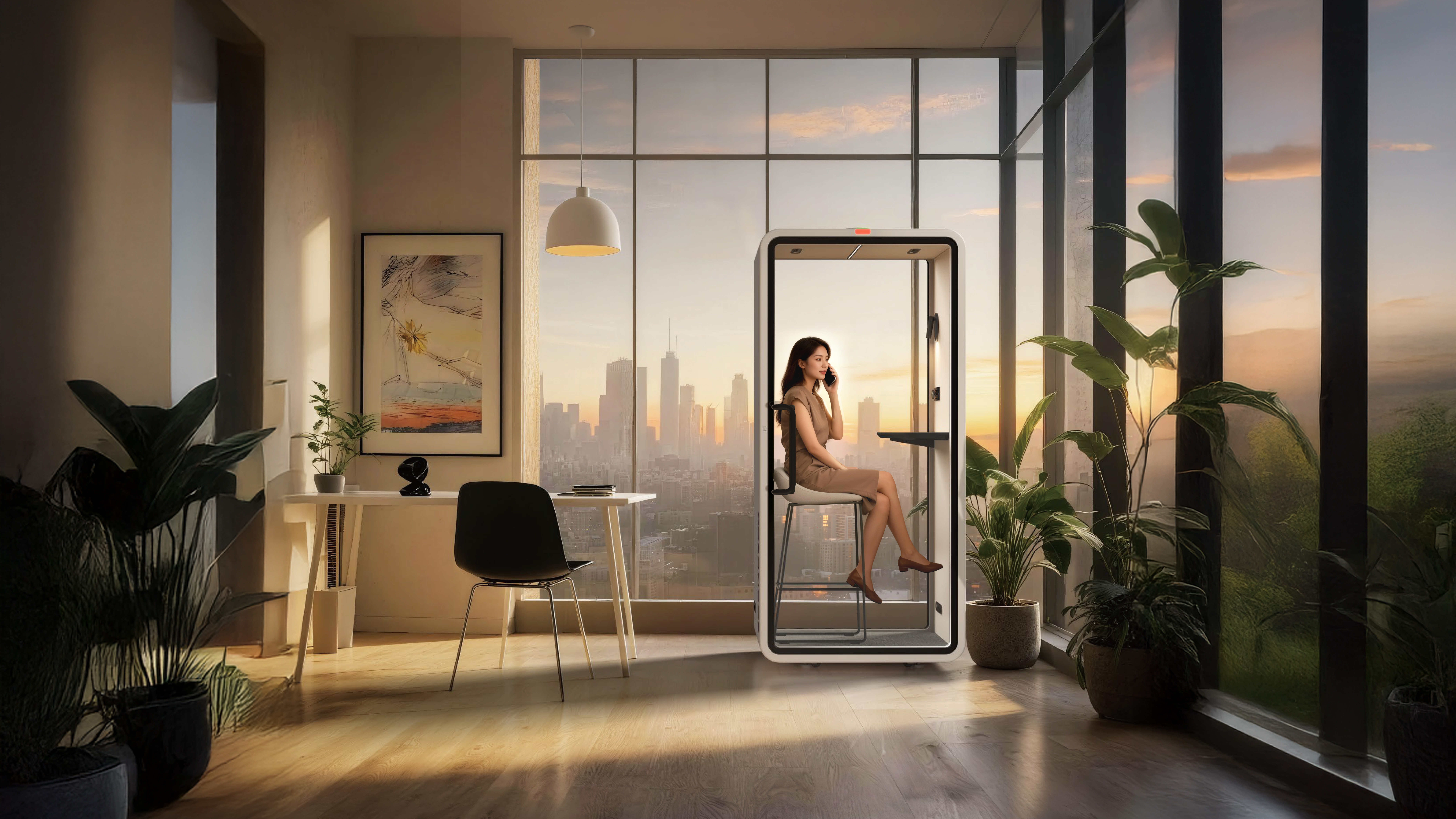
Yes. SoundBox pods use a six-component modular design that assembles in approximately 4 hours without professional tools. The same process reverses for disassembly. Because acoustic seals are built into the factory-manufactured panel joints (not field-applied caulking), pods can be relocated without degradation in sound isolation performance. This is a significant advantage over built-in acoustic rooms and over competing pods that require professional installation teams.
What certifications should I look for in an office pod?
For acoustic performance: ISO 23351-1 Class A certification (SoundBox VRT and ART series), ASTM E90 test reports, and reliable Ds.A values from accredited laboratories. For safety: UL certification (SoundBox holds UL E523389). For indoor air quality: GREENGUARD Gold certification (SoundBox VRT series holds certification 422773-420), which is the stricter tier designed for sensitive environments like schools and healthcare facilities. For the European market: CE marking. Emissions compliance (such as E0 under GB/T 18883-2002) is also important because pods are small enclosed spaces where VOC accumulation has a direct impact on occupant health.
How does ventilation work in a soundproof pod without letting sound in?
SoundBox uses a hidden maze airflow design with Panasonic ventilation fans. The air path routes through a series of internal baffles that force sound waves to navigate multiple 90-degree turns through absorptive surfaces. Each turn attenuates sound energy while air flows freely. This achieves effective air exchange without creating an acoustic weak point at the ventilation opening. Conventional designs that use simple grill openings sacrifice either airflow (restricting the opening for sound control) or acoustic performance (using larger openings for better airflow).
Conclusion
Choosing a soundproof office pod comes down to verified data, not marketing language. The relevant questions are: Does the pod hold ISO 23351-1 Class A certification? What is the specific Ds.A value? Was it tested to recognized standards? Does the ventilation compromise the acoustic seal? Are the materials safe for enclosed occupied spaces? Is the test data published with report numbers you can verify?
SoundBox answers these questions with specific, independently verified data: ISO 23351-1 Class A certification across VRT and ART product lines (ART series: 30.2–31.0 dB Ds.A with individual test reports for each model), ASTM E90 laboratory test reports with published report numbers, GREENGUARD Gold and UL safety certifications, Panasonic ventilation with maze airflow design, and E0 emissions materials with zero benzene.
Backed by 17 years of acoustic engineering, 200+ patents, a CNAS-accredited testing center with B&K instrumentation, and an underground anechoic chamber developed with Tsinghua University, SoundBox designs pods from the acoustics outward — not the aesthetics inward.
*Explore the full SoundBox pod lineup and compare specifications across the VRT, ART, and ART+ series at soundbox-pod.com. Download the ISO 23351-1 acoustic test reports and detailed technical data sheets for each model.*